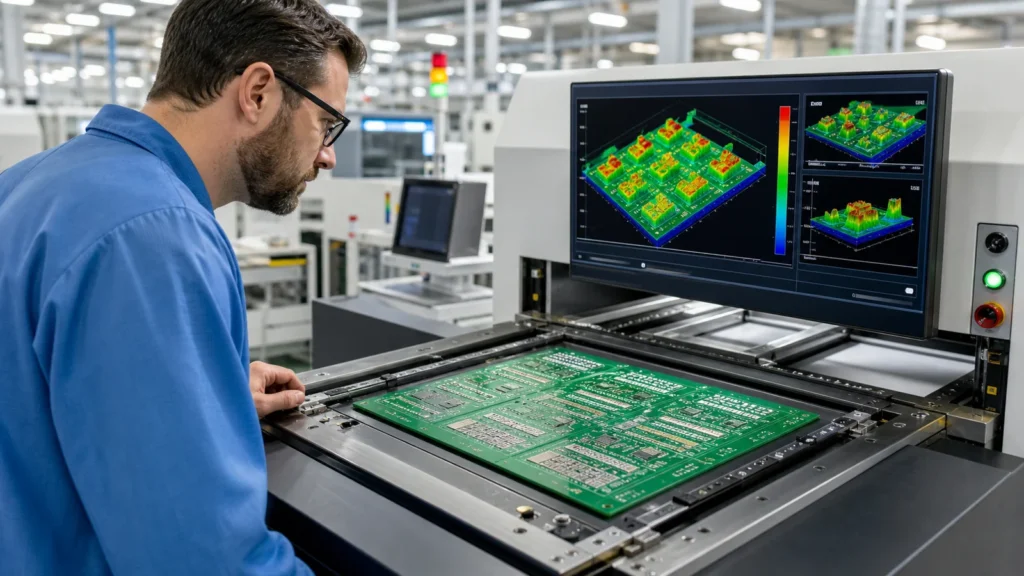
Solder paste inspection is one of the earliest places where an SMT line can prove whether stencil printing is under control or quietly drifting toward defects. Reflow ovens, AOI, and functional tests all matter, but if the paste deposit is already too small, too tall, offset, or bridged before placement, later stations are forced to clean up a problem that started at the printer.
For PCB assembly teams, SPI is not just a machine that paints pass or fail colors on a screen. It is a process-control checkpoint that shows whether aperture design, paste condition, stencil cleanliness, support tooling, board warpage, and printer settings are producing repeatable deposits. When engineers use SPI data well, they can reduce tombstoning, opens, shorts, head-in-pillow risk, and avoidable rework before those failures consume line time.
What SPI Measures After Printing
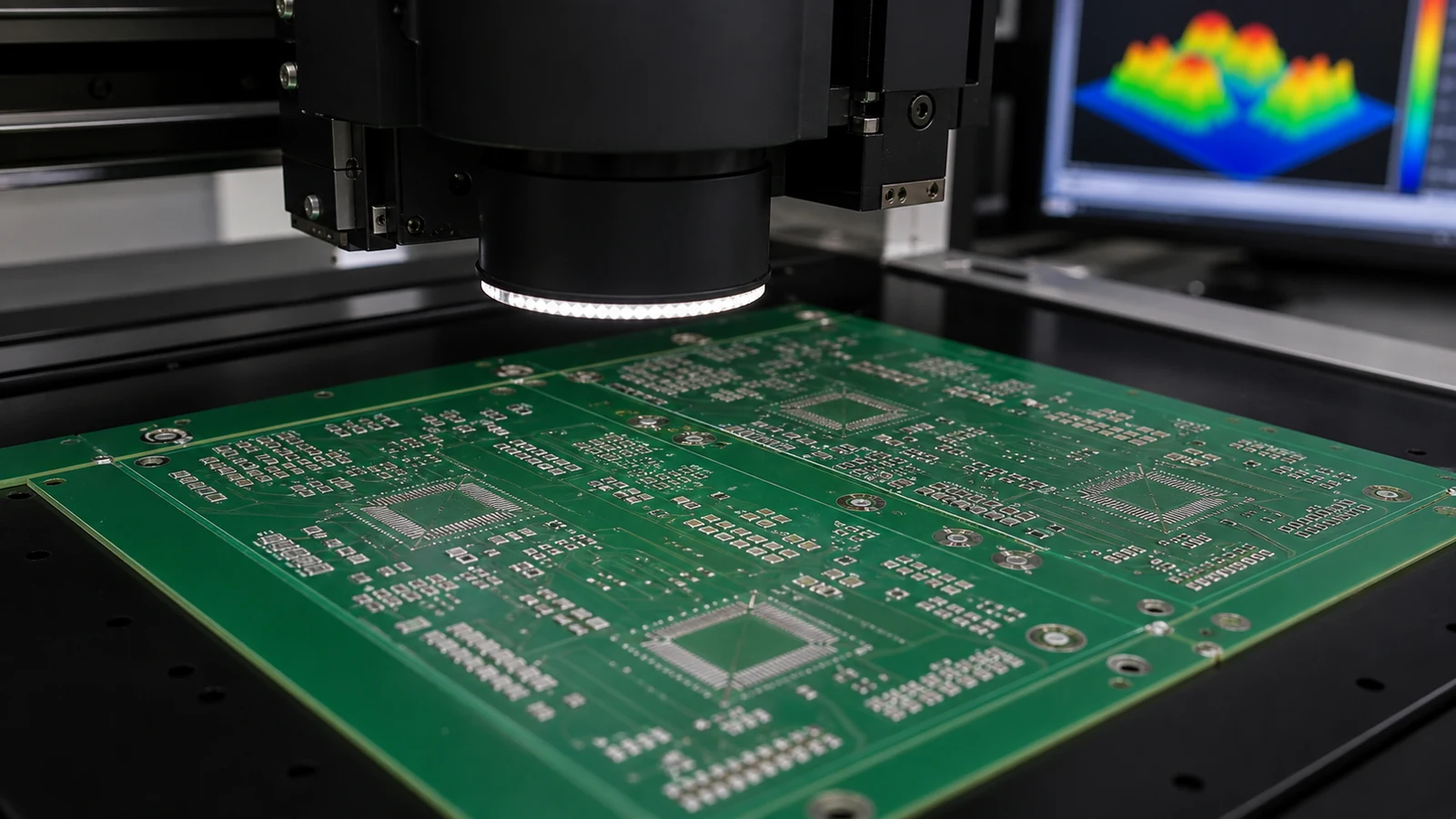
In a real SMT line, solder paste inspection usually happens immediately after stencil printing and before pick-and-place. The goal is to measure whether each printed deposit matches the process window the assembly actually needs. The most common checks are paste area, height, volume, positional offset, and bridge formation between adjacent pads. On fine-pitch devices, even small volume loss or slumping can create opens or shorts later in reflow.
The exact threshold depends on the package, stencil design, paste type, and product risk. A large connector pad can tolerate variation that would be unacceptable on a QFN thermal pad edge or a 0.4 mm pitch lead frame. That is why a useful SPI program starts from the assembly drawing, stencil apertures, and component mix rather than applying one generic tolerance band across the entire board.
Why SPI Matters More Than a Simple Pass or Fail
Many teams first ask, “what is solder paste inspection supposed to catch?” The better question is what trend it exposes before defects escape. A single fail may point to a dirty stencil aperture, unstable squeegee pressure, poor board support, misalignment, or degraded paste chemistry. A rising pattern of marginal deposits across one board edge may point to warpage, tooling support issues, or a printer setup drift that AOI will only see later as a placement or soldering symptom.
This is where SPI becomes more valuable than a binary gate. If the system records measurement trends by pad type, board area, or print cycle count, process engineers can intervene before the line produces a full batch of latent defects. That makes SPI especially important for assemblies with fine-pitch ICs, bottom-terminated components, mixed paste volumes, dense LED layouts, and boards that already have narrow yield margins.
Common SPI Metrics Engineers Should Watch
Volume is often the headline metric because it correlates strongly with whether enough solder is available to form a reliable joint. Height helps reveal whether the deposit shape is collapsing, peaking, or smearing. Area and offset show whether the print landed where it should and whether aperture release is stable. Bridging alarms matter most around narrow spacing, but they should be interpreted alongside the actual print image instead of trusted blindly.
Good engineering practice is to separate critical pads from routine pads. Thermal pads, fine-pitch leads, BGA escape regions, and analog reference devices often deserve tighter control than larger passive pads. If all pads use the same limit window, the SPI report may look healthy while the parts that drive field reliability remain under-controlled.
Where SPI Fits Between Printing, Placement, and Reflow
SPI does not replace printer setup, stencil design review, or downstream inspection. It sits between those activities and makes each of them more effective. A weak stencil design can still pass if limits are too loose. A perfect SPI result can still be followed by placement defects if components shift or nozzles mis-pick. And a stable print does not eliminate the need to manage the reflow profile and oven process. But without SPI, many print-related defects remain invisible until they become more expensive to debug.
That is why many high-yield SMT lines use SPI together with a disciplined solder paste control plan. Paste storage, thaw time, humidity exposure, stencil wipe intervals, under-stencil cleaning, and print cycle count all influence the deposits that SPI sees. The inspection machine is only as useful as the process discipline around it.
Typical Causes Behind SPI Failures
When an SPI system starts flagging repeated failures, the root cause is often mechanical or material, not software. Common causes include worn or damaged stencil apertures, incorrect snap-off or separation behavior, poor board support under large arrays, contaminated paste, low paste roll, incorrect squeegee speed, and alignment drift. On ultra-fine features, even a small mismatch between aperture design and paste particle size can create unstable release behavior.
The fastest troubleshooting path is usually to group failures by pattern. Are they concentrated on one component type, one board corner, one print cycle interval, or one side of the stencil? Pattern-based analysis prevents wasted time on random cleaning or parameter changes. It also helps determine whether the corrective action belongs at the printer, in stencil design, or in the assembly documentation that was released to production.
How SPI Data Improves Yield Instead of Filling Reports
SPI becomes worth the investment when its data changes operator behavior and engineering decisions. The best lines use alarm limits for stop conditions and separate control limits for drift detection. If deposits are still within acceptance but trending down on a critical footprint, the line can pause for stencil cleaning or paste refresh before true failures appear. If one aperture family repeatedly underfills, the right fix may be a stencil revision, not repeated operator intervention.
Teams that link SPI findings to AOI and rework records also learn faster. For example, if one QFN edge repeatedly shows low-volume SPI readings and later AOI bridges or opens, the process window is already telling a coherent story. The same feedback loop supports broader DFM decisions when engineers need to tighten land patterns, aperture reductions, or assembly notes for the next revision.
When SPI Is Most Valuable
Not every assembly line needs the same SPI depth, but the value rises quickly on boards with dense SMT populations, bottom-terminated packages, fine-pitch ICs, mixed technology, and high reliability requirements. Medical, automotive, industrial control, RF, and communications products often benefit because one unstable print variable can affect many hidden joints at once. SPI is also valuable when a new stencil, new paste, or new product introduction is entering production and the line needs objective evidence that printing is stable.
For lower-volume or less complex boards, even a simpler SPI strategy can still reduce surprises. The key is to match the inspection effort to the actual defect risk. Measuring everything with maximum sensitivity can create noise. Measuring the wrong pads can create false confidence. Measure what matters to joint formation and downstream yield.
A Practical SPI Checklist for PCB Assembly Teams
Before relying on SPI, confirm that the assembly package defines critical components, stencil assumptions, target paste type, and acceptable print variation. Check whether printer settings are locked and traceable, board support is stable, cleaning frequency is defined, and paste handling rules are followed consistently. Then confirm that SPI programs prioritize the footprints most likely to create reflow escapes or costly rework.
Used properly, solder paste inspection is one of the strongest early-warning tools in SMT manufacturing. It helps engineers catch print drift while the board is still cheap to correct, ties print behavior to real defect mechanisms, and gives PCB assembly teams a clearer path from raw data to yield improvement.
FAQ
What is solder paste inspection in SMT?
Solder paste inspection, often called SPI, is the measurement step after stencil printing that checks paste deposits for volume, height, area, offset, and bridging before components are placed.
Is SPI the same as AOI?
No. SPI checks printed solder paste before placement and reflow, while AOI inspects placed parts and visible soldering results later in the assembly flow.
Why is solder paste volume important?
Paste volume strongly affects whether a joint forms correctly. Too little paste can create opens or weak joints, while too much paste can increase bridging and solder-ball risk.
What usually causes repeated SPI failures?
Repeated SPI failures often come from stencil contamination, poor board support, alignment drift, unstable paste condition, incorrect print parameters, or aperture designs that do not release paste consistently.