Ask an electronics student what is RMS and you will usually get “root mean square.” That is technically correct. But if you stop at the math, you miss what RMS actually means for real-world circuit work: it is the DC-equivalent value that tells you how much heating an AC waveform delivers. This article explains the meaning of RMS in terms that help you take better measurements and make safer design decisions.
The Straightforward RMS Meaning
RMS stands for Root Mean Square. For any periodic waveform, RMS is calculated by squaring the instantaneous values, averaging the squares over one period, and taking the square root. The result is a single number that represents the effective DC value of that AC signal.
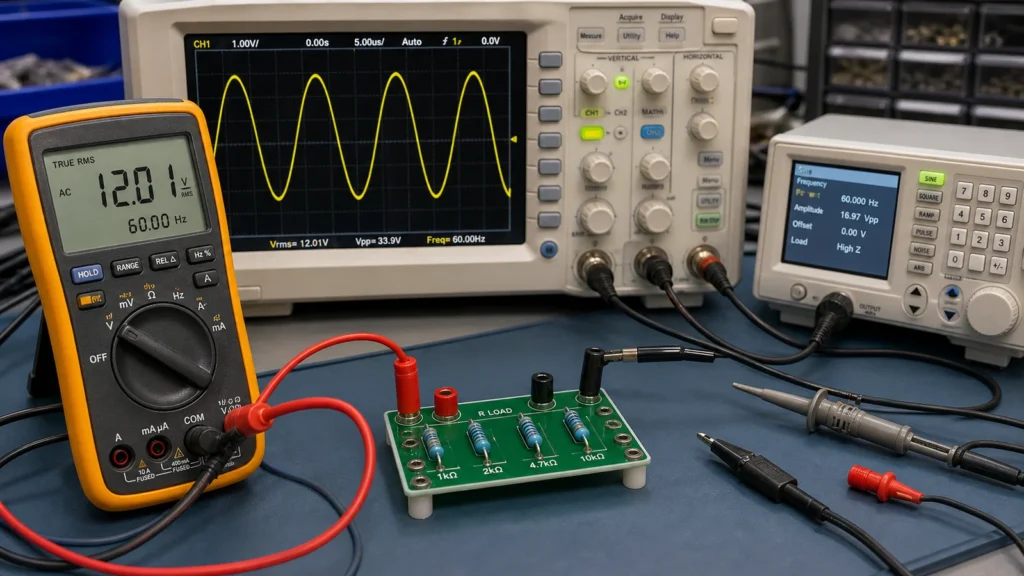
The critical insight: if you pass an AC voltage of 10 V RMS through a resistor, it generates the same heat as 10 V DC. That is why what is RMS matters — it is the number your multimeter reports on the AC range, and it is the number that determines whether a component exceeds its power rating.
Why Engineers Use RMS Instead of Peak or Average
AC waveforms constantly change. You cannot describe them with a single instantaneous value. Three candidates exist:
- Peak voltage (Vₚ): The highest instantaneous value. For a 120 V RMS wall outlet, Vₚ = 170 V. Useful for insulation ratings but misleading for power calculations.
- Average voltage: The arithmetic mean of the absolute value over one cycle. For a sine wave, this equals 0.637 × Vₚ. Almost no one uses this in practice.
- RMS voltage: The DC-equivalent heating value. For a sine wave, Vᵣₘₛ = Vₚ ÷ √2 ≈ 0.707 × Vₚ. This is the number that matters for real power and thermal calculations.
If you mistakenly use peak voltage in a power calculation, you overestimate dissipation by a factor of 2. A resistor that should handle 1 W based on peak voltage actually sees 2 W — and fails.
RMS Values for Common Waveforms
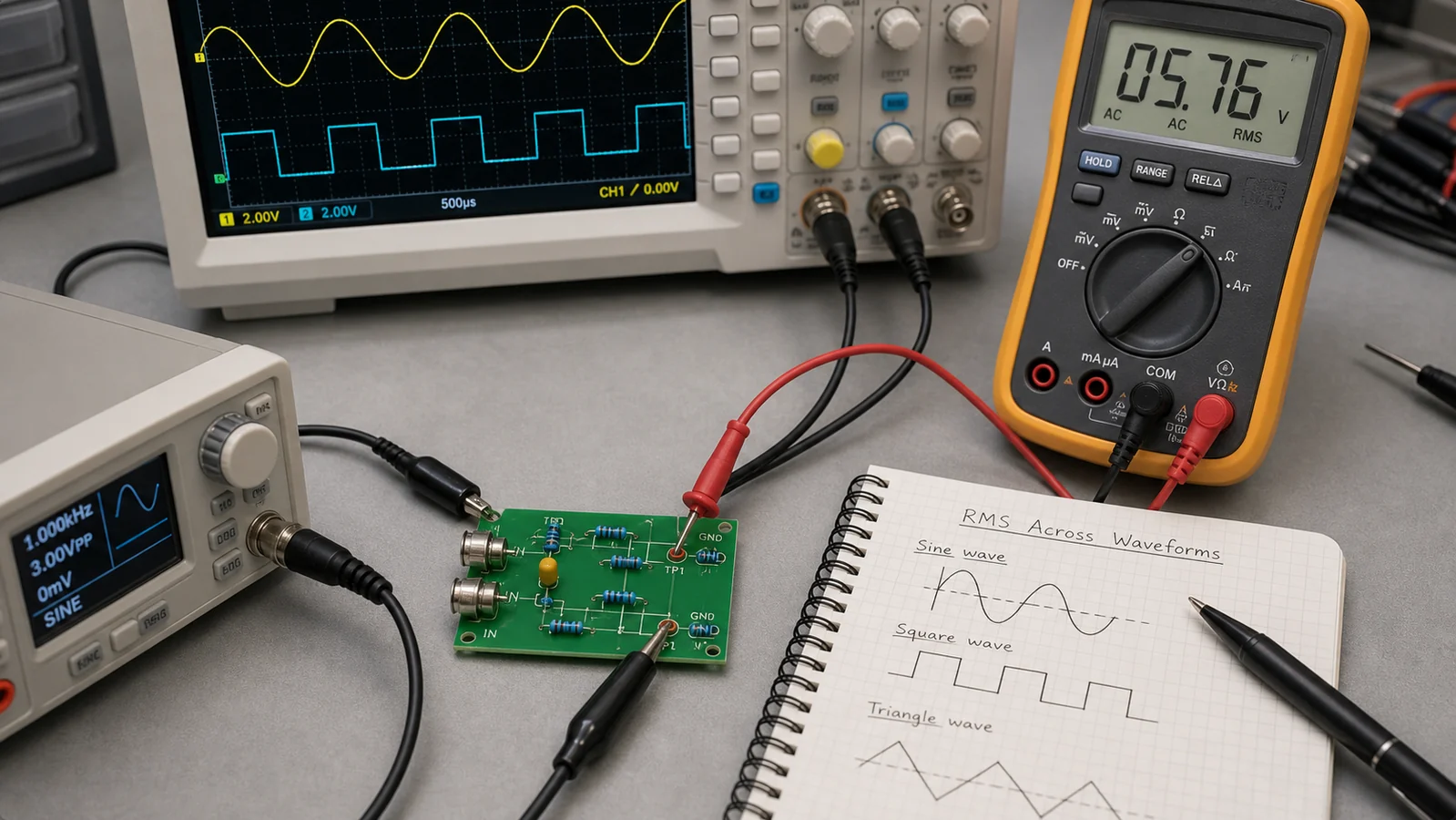
The relationship between peak and RMS depends on waveform shape. Pure sine waves follow a clean ratio, but real circuits rarely produce textbook sine waves:
| Waveform | Vᵣₘₛ / Vₚ Ratio | Example |
|---|---|---|
| Sine wave | 1 / √2 ≈ 0.707 | Wall AC, pure inverter output |
| Square wave (50% duty) | 1.0 | Ideal digital clock signal |
| Triangle wave | 1 / √3 ≈ 0.577 | Function generator output |
| PWM (variable duty D) | √D | Motor drive, LED dimmer, SMPS |
| Rectified sine (full-wave, unfiltered) | 0.707 | Bridge rectifier before capacitor |
A cheap multimeter that assumes a sine wave will give incorrect RMS voltage readings on a PWM signal. If your measurement must be accurate across arbitrary waveforms, you need a true-RMS meter.
True-RMS vs. Average-Responding Meters
Many affordable multimeters are average-responding: they measure the average absolute value, multiply by 1.11 (the sine-wave form factor), and display the result as “RMS.” This is correct only for pure sine waves. Feed a triangle wave to an average-responding meter and the displayed value will be wrong by about 4%. Feed a PWM signal and the error can exceed 40%.
A true-RMS meter computes the actual RMS value by sampling the waveform at high speed, squaring each sample, averaging, and taking the square root. These meters handle arbitrary waveforms correctly. If your work involves inverter outputs, motor drives, audio amplifiers, or non-sinusoidal supplies, true-RMS is not optional.
Practical Scenarios Where RMS Matters
- Fuse and breaker sizing: Fuses respond to RMS current, not peak. A 5 A fuse on a circuit carrying 5 A RMS will operate correctly. If you size based on peak current, the fuse rating is wrong.
- Transformer VA ratings: A transformer rated 100 VA at 120 V RMS can deliver about 0.83 A RMS. Exceeding this overheats the windings even if the peak current looks moderate.
- Speaker power handling: Audio amplifier specs use RMS watts. A speaker rated 50 W RMS can dissipate that much continuous power. Peak power ratings (often 2x or more) are marketing numbers, not design numbers.
- Capacitor ripple current: Electrolytic capacitors have a maximum RMS ripple current rating. Exceeding it causes internal heating and shortens capacitor life, even if the DC voltage stays within spec.
- PCB trace width: Trace width calculators use RMS current to determine temperature rise. Peak current spikes shorter than the thermal time constant may be acceptable, but continuous RMS current determines the steady-state temperature.
How to Calculate RMS Without Memorizing Formulas
You do not need to derive integrals every time. Here is a practical workflow:
- Capture the waveform with an oscilloscope. Export a CSV of time-voltage pairs.
- Square each voltage value. In a spreadsheet, create a column for V².
- Average the squared values over one complete cycle (or an integer number of cycles).
- Take the square root of that average. The result is the RMS voltage.
For a sine wave, the shortcut Vᵣₘₛ = Vₚ × 0.707 works. For everything else, compute it or use a true-RMS meter. Guessing with the sine-wave formula on a non-sinusoidal waveform is how thermal problems sneak into production.
Frequently Asked Questions
What is RMS in simple terms?
RMS, or Root Mean Square, is the effective value of an AC voltage or current. It tells you the equivalent DC value that would produce the same heating effect in a resistor. A 120 V RMS wall outlet delivers the same heating power as 120 V DC.
What is the RMS meaning in electrical engineering?
In electrical engineering, the meaning of RMS is the DC-equivalent magnitude of a time-varying waveform. It is the standard way to express AC voltages and currents because it directly relates to real power: P = Vᵣₘₛ × Iᵣₘₛ for resistive loads.
Why is RMS used instead of average?
The average of a pure AC sine wave over a full cycle is zero. Even the average of the absolute value does not correctly predict heating. RMS squares the values before averaging, which correctly weights larger excursions and produces the DC-equivalent heating value.
Do I need a true-RMS multimeter?
If you only measure pure sine waves (wall AC, linear power supplies), an average-responding meter is adequate. If you work with inverters, motor drives, PWM signals, audio, or any non-sinusoidal waveform, a true-RMS meter is essential.
What is the RMS value of a 120 V wall outlet?
120 V is the RMS value. The peak voltage is approximately 170 V (120 × √2), and the peak-to-peak voltage is 340 V. This is why a 120 V RMS outlet can deliver a 170 V peak to a rectifier’s filter capacitor.
What is the RMS of a square wave?
For an ideal square wave that swings between +Vₚ and -Vₚ with 50% duty cycle, the RMS value equals Vₚ. There is no 0.707 factor because the waveform spends equal time at the peak positive and peak negative values.