Rigid-flex PCB cost usually surprises teams that budgeted the project like an ordinary multilayer board with a flexible tail. The premium rarely comes from a single line item. It comes from bend-zone rules, special materials, extra lamination steps, tighter process controls, and the yield loss that appears when those choices are not coordinated early. If you need a realistic quote for a rigid flex PCB cost review, the useful question is not “How much per board?” but “Which design decisions are forcing process complexity, scrap risk, and extra inspection?”
Rigid-flex pricing breaks away from standard PCB pricing very early
A rigid-flex build stops behaving like a standard FR-4 job as soon as the circuit has to survive both assembly heat and mechanical bending. The board house is no longer quoting only board area, layer count, and finish. It is pricing flex materials, coverlay behavior, stiffener construction, transition-zone registration, tooling for unusual outlines, and the probability that one weak detail will reduce panel yield.
That is why a flex PCB cost estimate often looks inconsistent when two designs have similar dimensions. One project may have a gentle static bend, wide copper spacing, and simple rigid sections. Another may need controlled impedance through the transition, repeated flexing, laser-drilled microvias, and dense BGA fan-out near the rigid-to-flex interface. The outline may look similar, but the factory risk is not.
ReversePCB readers who already work with rigid-flex stackup choices will recognize the pattern: when the bend area is defined late, cost usually rises together with schedule risk.
The cost drivers that matter most in a rigid-flex quote
The biggest rigid flex PCB cost drivers are the ones that push the job away from standard materials and repeatable process windows. Those are the inputs that deserve scrutiny before you compare suppliers.
Material system and coverlay construction
Polyimide flex cores, adhesiveless laminates, coverlay films, bonding sheets, and stiffener materials cost more than ordinary rigid materials, but the purchase price is only part of the story. Material selection also changes drilling behavior, registration margin, thickness control, and bend reliability. A cheaper material stack can become an expensive build if it creates delamination risk after reflow or cracks during forming.
Stiffeners often look minor in the quote, yet they can change the real flex PCB cost quickly. FR-4, polyimide, stainless steel, and aluminum stiffeners all affect bonding steps, local thickness, assembly support, and connector durability. A connector landing that is under-supported may save a little on material while adding field failures, rework, or poor insertion life.
Layer count, lamination cycles, and via structure
Rigid-flex cost rises sharply when the stackup needs multiple lamination cycles, blind or buried vias, or HDI-style buildup around dense components. Sequential lamination is expensive because each cycle adds tooling, process time, alignment exposure, and more places for yield loss. Even when the rigid area seems ordinary, the transition between rigid and flex regions can drive extra fabrication controls that a simple multilayer PCB does not need.
Via structure matters because microvias and stacked builds force tighter process control than a through-hole design. If the project can escape dense fan-out by moving one connector, changing package pitch, or using a slightly larger rigid section, that layout decision can reduce cost more effectively than negotiating the final quote.
Panel utilization, outline complexity, and test coverage
Rigid-flex panels are not always efficient to nest. Long tails, odd bend arms, breakout tabs, and keep-out zones can waste usable panel area. Once panel utilization drops, the price per board rises even before the factory adds engineering time. This is one reason a small board can still carry a large premium.
Testing also matters. Dynamic-flex or high-reliability products may need tighter electrical verification, more inspection checkpoints, or coupons that confirm critical transitions survived the build. If a product will later face repeated bending, vibration, or connector cycling, the quote may include precautions that are invisible in the Gerbers but essential for yield protection.

Design decisions that inflate cost without helping the product
Not every premium is justified. Many expensive rigid-flex quotes trace back to design habits that look safe on paper but create unnecessary process difficulty.
One common mistake is using rigid-flex where a standard flex circuit with local stiffeners would solve the assembly problem more economically. Another is placing dense components too close to the transition zone, which forces routing compromises, coverlay openings, reinforcement features, or more complex stackups. Teams also overspend when they demand very tight mechanical packaging but leave no room for realistic bend radius, strain relief, or tooling rails.
Material over-specification is another frequent issue. Designers sometimes choose heavy copper, high-end material sets, or exotic finishes before checking whether the electrical and thermal requirements actually need them. The same pattern appears in rework-heavy prototypes: a board may be quoted for controlled impedance and premium flex materials, then damaged later because the assembly plan ignored local heat shielding and fixture support.
Before you lock the release package, compare the quote inputs against what the product really needs. ReversePCB’s stackup tradeoff guide and material guide are useful internal references for that review.
When rigid-flex still lowers total product cost
A rigid-flex design can absolutely be the cheaper system decision, even when the bare board price is higher. The savings show up when it removes connectors, wiring harnesses, manual assembly steps, mis-plug risk, enclosure volume, and vibration failures. In a tight product, a more expensive board can reduce total build cost by cutting parts count and rework exposure.
This is especially true when the alternative is a cable-and-connector architecture that needs repeated hand assembly, separate test fixtures, or service troubleshooting for intermittent interconnect faults. A realistic cost review should compare total product cost, not only the board quote. If a rigid-flex architecture removes two connectors, one bracket, and one labor-heavy assembly step, the board premium may be justified very quickly.
How to ask for a better rigid-flex quote
If you want a more stable quote and fewer DFM surprises, send the supplier a package that answers the real manufacturing questions early.
- Define whether the bend is static or dynamic, plus the expected bend direction and cycle life.
- Show the bend area, no-go zones, and component keep-out requirements clearly.
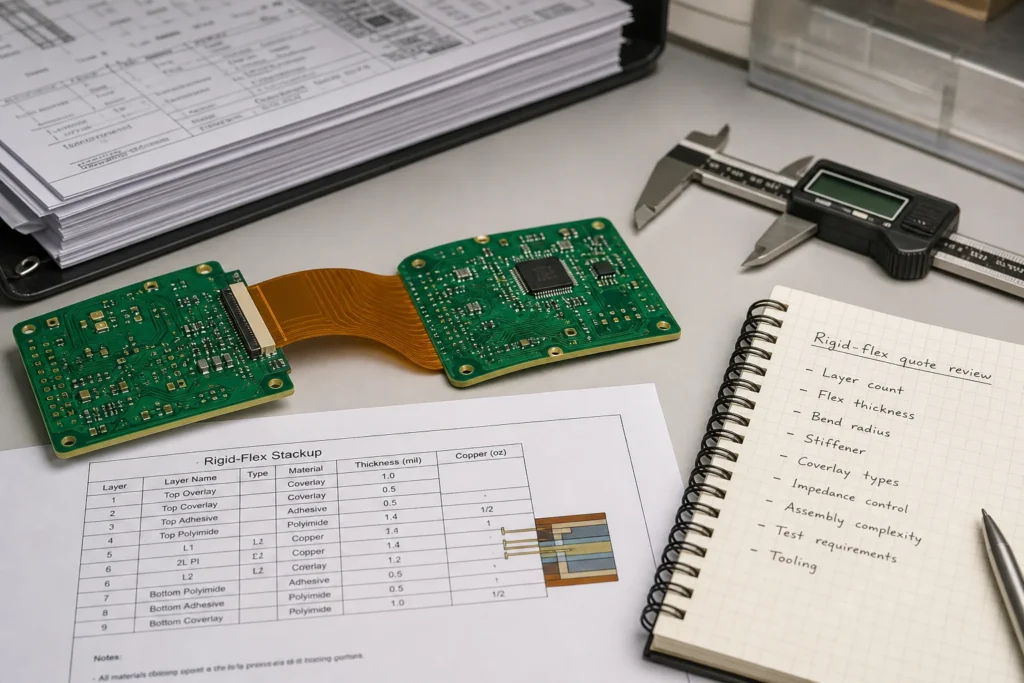
- Specify the intended stackup, copper weights, coverlay approach, and any impedance needs through the rigid-to-flex transition.
- Identify stiffener locations, thickness targets, and connector or component support requirements.
- Call out whether the board will face hand rework, selective shielding, or unusual thermal exposure during assembly.
- Ask the supplier to flag any yield-sensitive geometry before the design is frozen.
That checklist improves pricing accuracy because it reduces guesswork. It also prevents the classic late-stage problem where the first quote looked attractive only because key bend and support details were missing.
The practical way to judge rigid-flex PCB cost
The fastest way to lose money on rigid-flex is to chase a low unit price before the bend mechanics, stackup, and assembly realities are fully defined. The better approach is to ask which features are buying true product value and which are only compensating for avoidable layout or packaging decisions. Once you frame the quote that way, rigid flex PCB cost becomes easier to control.
For many teams, the right next step is not immediate price comparison. It is a short DFM review of bend zones, stiffener needs, via strategy, and panel efficiency before sending the RFQ. That usually saves more than squeezing the supplier after the design is already locked.
FAQ
Why does rigid-flex PCB cost rise faster than ordinary multilayer PCB cost?
Rigid-flex boards combine rigid and flexible materials, special bonding steps, bend-zone rules, and often lower panel efficiency. Cost rises further when the design also needs sequential lamination, stiffeners, controlled impedance, or dense routing near the transition zone.
What is the biggest avoidable cost driver in a rigid-flex design?
A poorly defined bend area is one of the biggest avoidable drivers. When bend radius, keep-out zones, stiffener needs, and transition routing are left vague, suppliers price more conservatively and yield risk increases during fabrication and assembly.
Can rigid-flex still be cheaper than a cable-and-connector approach?
Yes. The bare board may cost more, but total product cost can drop if rigid-flex removes connectors, harnesses, assembly labor, enclosure volume, or intermittent interconnect failures. The right comparison is system cost, not board price alone.
What should I send with an RFQ to get a more realistic rigid-flex quote?
Include the bend type and cycle expectation, stackup intent, coverlay and stiffener details, rigid-to-flex transition rules, impedance needs, and any assembly or rework constraints. A quote is much more reliable when those process-sensitive details are defined up front.