Vapor phase reflow usually enters the conversation when a normal convection profile no longer feels trustworthy. The line may already be stable on mainstream products, but a new assembly shows large thermal imbalance, sensitive bottom-terminated packages, or a narrow gap between insufficient wetting and overheating. At that point, the issue is not whether a board can be reflowed in principle. The issue is whether the process margin is wide enough to survive production variability without turning every run into profile babysitting.
That is why vapor phase reflow should be discussed as a manufacturing decision, not as a novelty process. Engineers often hear broad claims about uniform heating or reduced oxidation, but what matters on a real PCBA is whether the method fixes a specific weakness in the current line. If the board already runs cleanly through a tuned convection line, changing process families may add complexity without returning much value. If the board has heavy copper zones, dense thermal masses, difficult voiding behavior, or components that respond badly to uneven heating, vapor phase reflow can become a practical answer rather than a special-case curiosity.
This guide focuses on that decision point. It assumes you already understand the basics of a reflow process soldering guide and instead asks a more useful question: when does vapor phase reflow solve a real production problem better than standard oven profiles?
What vapor phase reflow changes at the heat-transfer level
In a convection oven, heat transfer depends on air or nitrogen flow, board orientation, conveyor behavior, and how different parts of the assembly absorb thermal energy over time. That arrangement works well for a large share of SMT production, but it also means the process window can narrow quickly when the board contains both light and heavy thermal zones. A massive connector shield, large ground plane, power module, or thick copper region may lag behind smaller components that are already approaching their practical thermal limits.
Vapor phase reflow changes the mechanism. Instead of relying on convective gas movement alone, the assembly is exposed to a controlled vapor medium that condenses on cooler surfaces and releases latent heat. That tends to drive the board more uniformly toward the boiling-point ceiling of the working fluid. The result is not magic, but it is a meaningful process characteristic: the board cannot keep climbing far above the medium temperature in the same way a poorly managed oven profile sometimes can.
For process engineers, that ceiling matters. It can make thermal behavior more predictable when a dense board has components with different heat-absorption patterns. It does not remove the need for profiling, paste qualification, or layout-aware design, but it changes the way thermal energy reaches the assembly and therefore changes the risk profile of certain products.
Where vapor phase reflow can outperform a standard SMT oven
Mixed thermal masses that refuse to balance
The clearest use case is a board that combines delicate small parts with stubbornly slow-heating regions. In a convection oven, the profile may be tuned until the heavy area finally reaches acceptable soldering temperature, only to leave smaller nearby components exposed too aggressively. Vapor phase reflow often improves that balance because heat delivery is less dependent on local airflow behavior and more tied to condensation at cooler surfaces.
Bottom-terminated components and void-sensitive joints
Packages such as QFNs, large thermal pads, and some power devices can make process tuning uncomfortable because voiding, wetting quality, and thermal spread all interact. Vapor phase reflow is not a guaranteed void-reduction shortcut, but it can improve consistency enough that the engineer has a cleaner basis for comparing stencil, paste, soak behavior, and peak strategy. When the current line produces unstable void results, a process with tighter thermal uniformity may be easier to diagnose and control.
Assemblies where oxidation control and thermal ceiling both matter
Some teams are attracted to vapor phase reflow because the vapor environment naturally limits oxygen exposure around the board during the active heating stage. That can help, but it should not be treated as a free pass around poor paste handling or storage discipline. A better way to frame the benefit is this: when oxidation sensitivity and thermal-margin sensitivity are both real concerns, vapor phase may reduce the number of variables fighting each other at once. That makes process optimization more disciplined, especially when paired with a robust solder paste guide and print controls upstream.
What vapor phase reflow does not solve for you
Vapor phase reflow is often introduced with a clean list of advantages, but the production decision gets clearer once the tradeoffs are stated just as plainly. The process does not excuse weak stencil design, poor paste volume control, contaminated pads, or unrealistic component keep-out decisions. If the print itself is unstable, the right answer may still begin with solder paste inspection and upstream process correction rather than a new reflow method.
It also does not make equipment ownership trivial. Fluid handling, residue management, condensation behavior, throughput expectations, and maintenance routines all deserve attention before a product is moved over. A vapor phase system may create a better thermal environment for one difficult assembly while making the broader manufacturing flow less convenient if the volume is high and the product mix is already optimized for conveyor ovens.
There is also a planning risk: teams sometimes compare the best-case literature description of vapor phase reflow to the current worst-case profile on an oven line that has not been fully optimized. That comparison is too easy. A fair decision compares vapor phase against a well-tuned convection baseline and against realistic capital, cycle-time, and qualification effort.
How to validate the process before committing a product
Profile the real board, not a convenient proxy
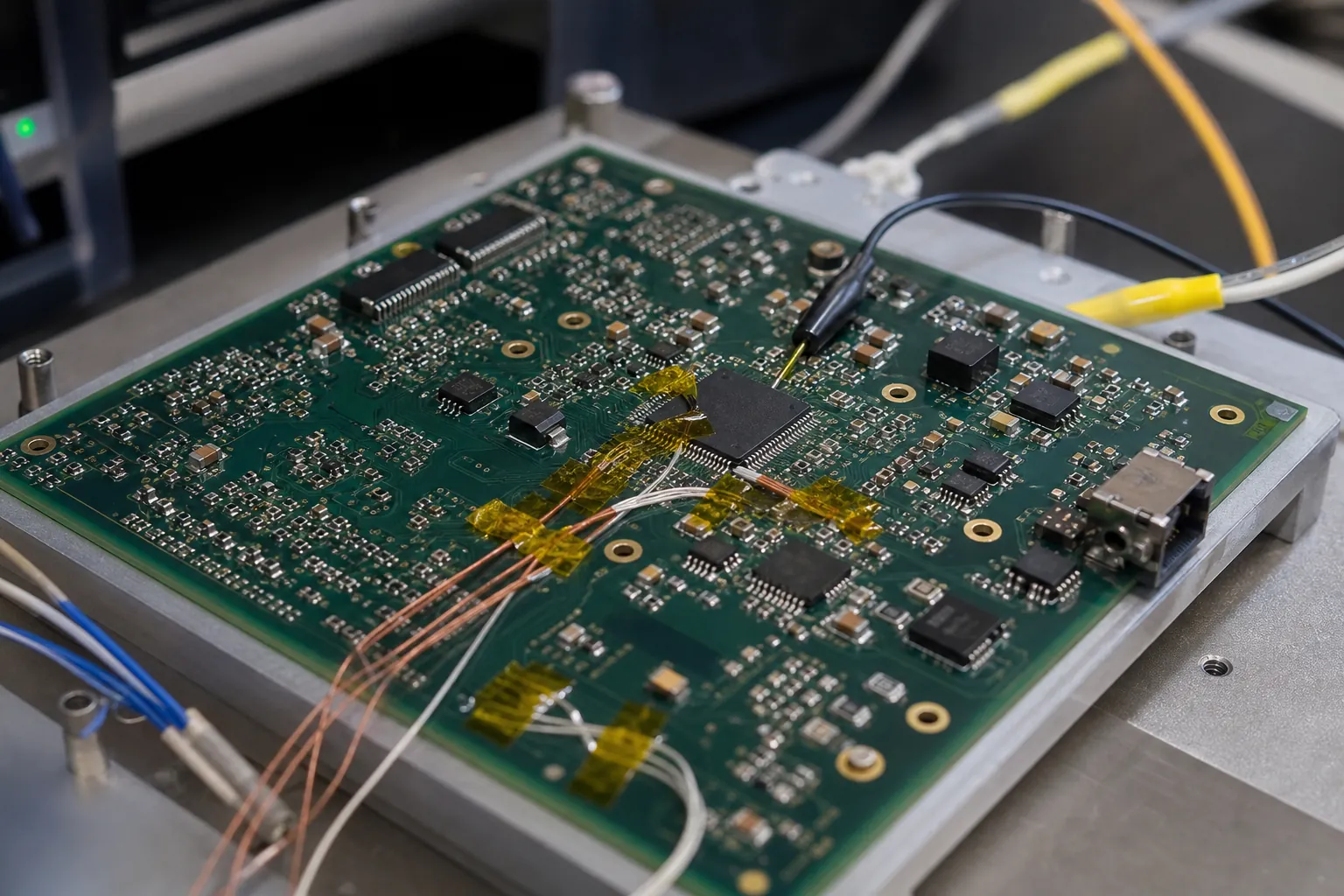
Validation starts with instrumenting the actual assembly, especially the hard-to-heat zones, large thermal pads, and temperature-sensitive components. If the process change is being justified by thermal balance, then the thermocouple map needs to reflect the real imbalance problem rather than a simplified coupon. The board should be tested with realistic component loading and practical fixturing, not a stripped demonstration version that hides the actual challenge.
Compare outcomes that matter to manufacturing yield
The most useful validation metrics are not abstract machine settings. They are observable outcomes: wetting quality, void distribution, component shift, residue behavior, peak consistency across thermal zones, and repeatability across multiple runs. If one process profile looks better on paper but creates handling or cleanliness issues downstream, that tradeoff belongs in the decision.
Keep the upstream and downstream checks in view
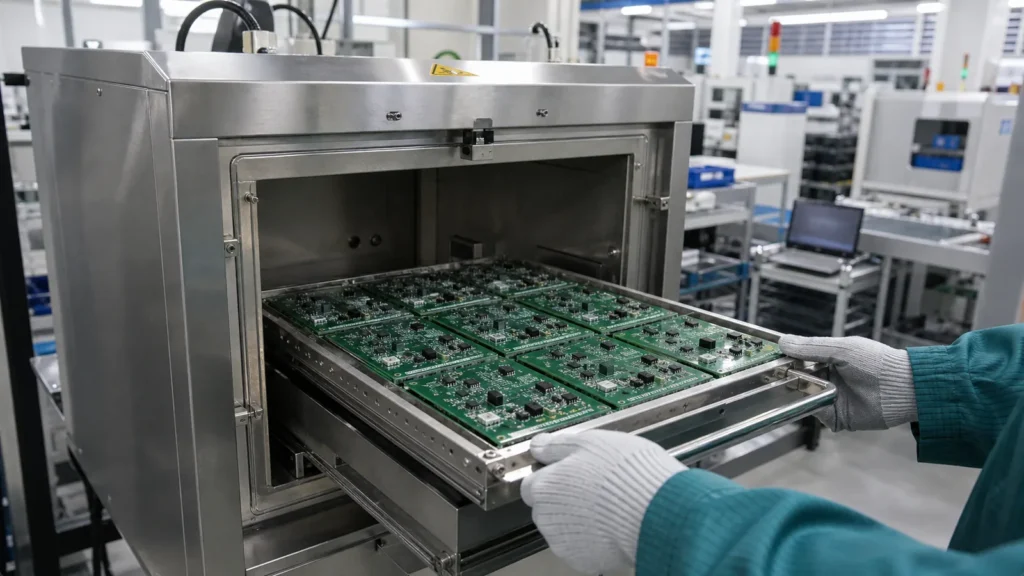
A process change should also be judged in context. If the board goes through curing, post-reflow inspection, X-ray, or later baking steps, the reflow decision should not be isolated from those realities. Teams that already rely on PCB ovens for reflow, curing, and baking often underestimate how much the full thermal chain matters. A board that looks improved immediately after vapor phase reflow may still need downstream handling rules that are different from the established oven workflow.
When staying with a standard oven is the better engineering answer
If the product family is already stable, throughput matters heavily, and the profile window can be widened by practical adjustments to paste, stencil, placement balance, or oven tuning, staying with convection is often the better business decision. Standard ovens are deeply understood in most SMT environments, and that maturity counts. A process only deserves to be replaced when the current line is failing a real production need, not because another method sounds cleaner in theory.
The same is true when the difficulty is mostly rooted in layout or package choice. If an assembly is sensitive because component spacing, thermal relief strategy, or copper imbalance were never optimized, a process change may only mask a design issue. In that situation, the right answer might be a design-for-manufacturing review before a reflow-platform change.
Conclusion
Vapor phase reflow earns its place when a board exposes the thermal limits of standard oven profiling. Its strongest value is not novelty; it is the ability to deliver a more controlled thermal ceiling and a more even response on difficult assemblies. That can reduce the tuning burden on boards with mixed masses, sensitive bottom-terminated packages, or unstable process windows.
But the right comparison is always practical. If a tuned convection line already delivers repeatable joints and acceptable yield, switching processes may create more work than benefit. If the current line keeps forcing compromises between cold heavy zones and overheated light zones, vapor phase reflow deserves serious evaluation. The disciplined path is simple: measure the real board, compare the real outcomes, and choose the process that gives production the wider margin, not the nicer marketing story.
FAQ
What makes vapor phase reflow different from a standard convection profile?
Vapor phase reflow heats the assembly through condensation of a controlled vapor medium rather than relying only on hot gas flow. That changes how heat reaches mixed thermal masses and also creates a temperature ceiling tied to the fluid boiling point.
When is vapor phase reflow worth testing on a PCB assembly?
It is worth testing when dense or mixed-mass boards show narrow process windows in convection, especially when heavy zones lag behind while smaller parts approach thermal limits. It can also be useful when bottom-terminated packages and void-sensitive pads need more stable thermal behavior.
Does vapor phase reflow automatically fix voiding problems?
No. It can improve thermal consistency, which may help process control, but voiding still depends on stencil design, paste choice, pad geometry, outgassing behavior, and profile details. The process must still be validated with X-ray or equivalent inspection.
Can a factory replace all convection reflow with vapor phase equipment?
Not always. Throughput, maintenance, fluid management, operating cost, and product mix all matter. Vapor phase reflow is often most valuable on specific difficult assemblies rather than as a universal replacement for a well-tuned convection line.