A PCB prototype is not just a smaller production order. It is the first point where schematic intent, layout decisions, assembly assumptions, and bring-up reality all meet the same physical board. When a prototype run goes badly, the cost is rarely the bare board itself. The real cost shows up as lost debug time, repeated spins, rushed BOM substitutions, and false confidence built on a prototype that never represented the production risk clearly in the first place.
That is why good prototype work is less about ordering a board quickly and more about deciding what the first build must prove. Sometimes the prototype must validate RF matching, sometimes it must confirm thermal margin, and sometimes it simply has to show that the assembly data package is clean enough for another team to build without guesswork. If you do not define that objective up front, a prototype can come back “assembled” and still fail its most important job.
What a PCB Prototype Is Supposed to Tell You
The first build should answer specific questions that simulation, review, and schematic checks cannot close by themselves. In practice, prototype boards usually need to validate one or more of these areas:
Electrical intent. Power rails start correctly, clocks behave, interfaces enumerate, and analog sections are stable enough for measurement.
Layout assumptions. Return paths, thermal spreading, connector access, and placement density hold up once real parts are installed.
Assembly readiness. Footprints, polarity marks, stencil assumptions, and pick-and-place data survive contact with manufacturing.
Service and debug access. Test pads, jumpers, probe clearances, and rework access are good enough for the people who must actually diagnose faults.
If the prototype is meant to answer all of those questions at once, the build usually gets overloaded. A better habit is to decide which risks matter most on spin one and then accept that some optimization can wait until the board proves the core concept.
Before You Order, Freeze the Data That Manufacturing Actually Uses
Many prototype delays start before fabrication. The board files may exist, but the manufacturing package is still inconsistent. A quick-turn prototype becomes much less useful when the assembler has to guess component orientation, substitute parts with no approval logic, or repair centroid data that was never checked against the final layout.
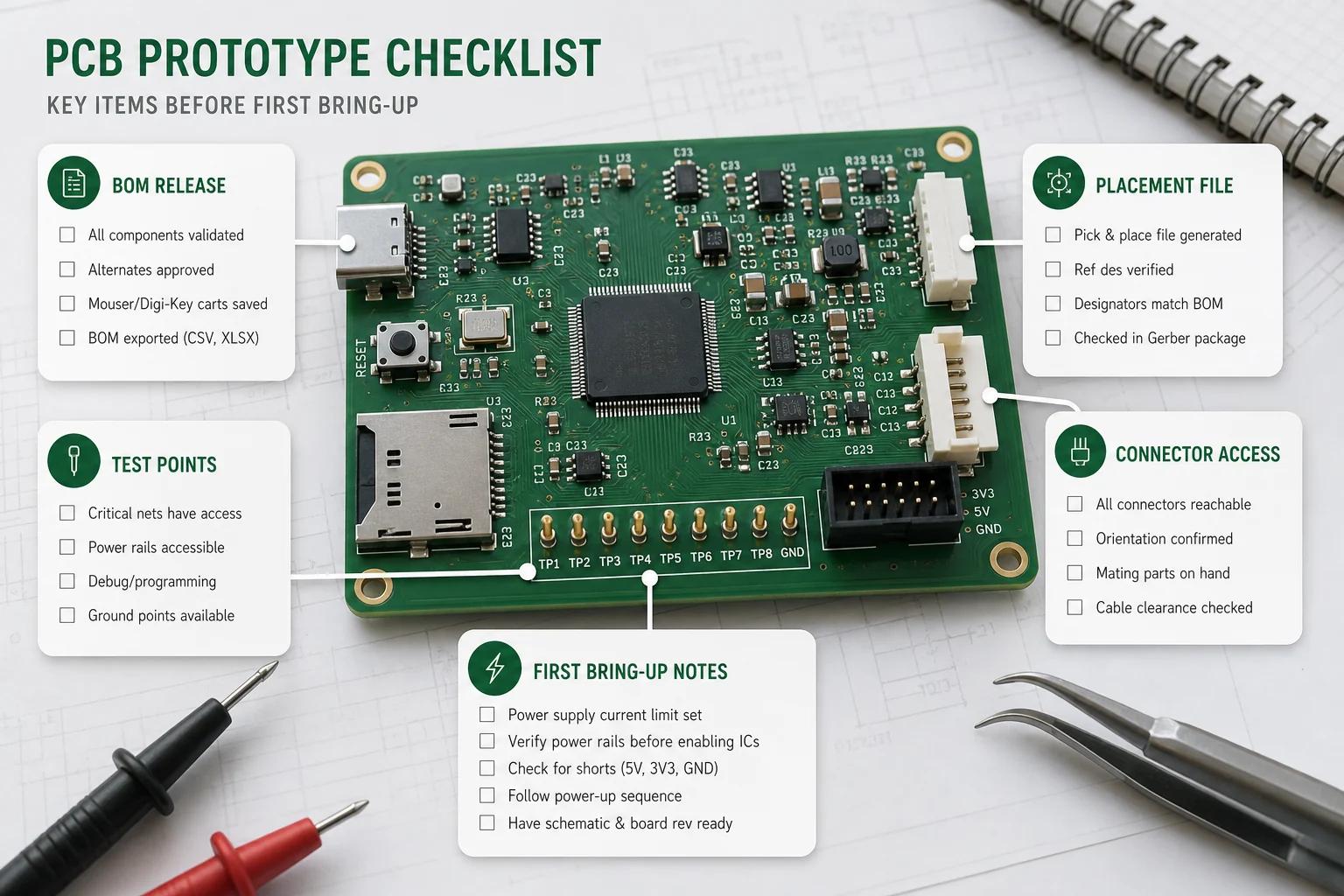
At minimum, the prototype package should align these items:
Fabrication outputs tied to the exact revision you intend to build.
BOM line items with approved manufacturer part numbers, not only distributor descriptions.
Placement data that matches reference designators, rotations, and board origin.
Assembly notes that explain special handling such as hand-loaded parts, no-stuff options, or thermal pad inspection.
Known-risk callouts for parts that may be supply substitutes, fragile during rework, or sensitive to moisture or profile changes.
This is where PCB BOM management checks and layout choices that affect inspection and rework stop being “production concerns” and become prototype concerns too. If the first build uses sloppy release data, the debug team ends up diagnosing document noise along with circuit behavior.
Prototype Boards Fail for Different Reasons Than Production Boards
On a prototype run, common failures are often not yield-driven in the same way they are on volume production. The first build fails because the design is still learning where its weak assumptions are.
Footprints are electrically correct but awkward to assemble. Thermal pads tombstone nearby passives, fiducials are poorly placed, or hand-rework access disappears next to a connector wall.
Bring-up access was treated as optional. The board works in theory, but reset, boot, UART, or current-measurement points are buried under shields or tall components.
One substituted component changes the whole conclusion. A different regulator ESR window, a slower MOSFET, or a new oscillator load condition makes the “prototype result” harder to trust.
Mechanical assumptions were never exercised. Heat sinks, standoffs, cable exits, and programming jigs interfere once the board is fully populated.
That is why prototype reviews should not stop at “does it power on?” A board that boots once on the bench may still be a poor prototype if it cannot be measured repeatably, reworked safely, or handed to a second engineer without tribal knowledge.
Where It Makes Sense to Spend More on the First Build
Engineers often try to make a prototype cheap in the wrong places. Saving money on a first build makes sense when the change does not reduce learning value. It does not make sense when the shortcut removes the exact evidence the prototype was supposed to produce.
Spend more on assembly clarity if a misloaded part would invalidate the test plan.
Spend more on test access if you expect firmware, power, or signal-integrity debugging on the bench.
Spend more on controlled substitutions if availability is unstable and the design is sensitive to part behavior.
Spend more on selective inspection for hidden joints, thermal pads, fine-pitch parts, or mechanically loaded connectors.
By contrast, cosmetic finish, over-optimized panelization, or production-level throughput planning can wait if they do not affect the prototype question you are trying to answer.
How to Use Prototype Feedback Before the Next Spin
The first build only pays off when its findings feed the next decision cleanly. Good teams record not just the failure, but the layer where the failure belongs:
Schematic issue: net naming, pull-up logic, rail sequencing, or component value selection.
Layout issue: coupling, clearance, test access, thermal spread, or connector orientation.
Assembly issue: stencil aperture, polarity marking, part height conflict, rework risk, or centroid error.
Release issue: BOM mismatch, wrong approved part, missing note, or ambiguous reference designator mapping.
That separation matters. If everything is logged as a generic “prototype problem,” the next revision gets patched instead of improved. A prototype board should teach the team which discipline needs the fix before the second spin locks in bad habits.
It also helps to compare the prototype findings against what would break in a real build transfer. Articles about PCBA manufacturing process control usually sound production-focused, but they are useful during prototype review because they expose which “small bench exception” would become a serious line problem later.
A Good Prototype Reduces Uncertainty, Not Just Time to First Board
The best PCB prototype is not the one that arrives fastest. It is the one that reduces the most uncertainty per build cycle. If the board teaches you where the design, assembly package, or debug plan was fragile, the prototype did its job even if it exposed painful issues. What wastes time is a fast first build that hides those issues until the design is already trying to act like production.
Prototype work goes well when the board is treated as an experiment with a manufacturing context, not just a shopping cart. Once that mindset is in place, quicker spins become more useful because each one answers a clearer question.
FAQ
What is the main purpose of a PCB prototype?
The main purpose is to reduce uncertainty before production. A prototype should confirm electrical behavior, expose layout or assembly risks, and show whether the release package is detailed enough for another team to build and debug the board correctly.
Should a prototype PCB use the same BOM as production?
As closely as practical, yes, but the important part is documenting controlled differences. If prototype substitutions are unavoidable, record which parts changed and whether they affect thermal margin, signal timing, startup behavior, or measurement conclusions.
Why do PCB prototypes fail even when the schematic is correct?
Because prototypes also test footprint choices, assembly data, test access, connector mechanics, and rework practicality. A correct schematic does not guarantee an easy first build if the manufacturing package or layout assumptions are weak.
What should be reviewed after the first prototype build?
Review electrical bring-up results, assembly defects, rework difficulty, document mismatches, and whether the board answered the original prototype objective. That review is what turns one board spin into a better second revision.