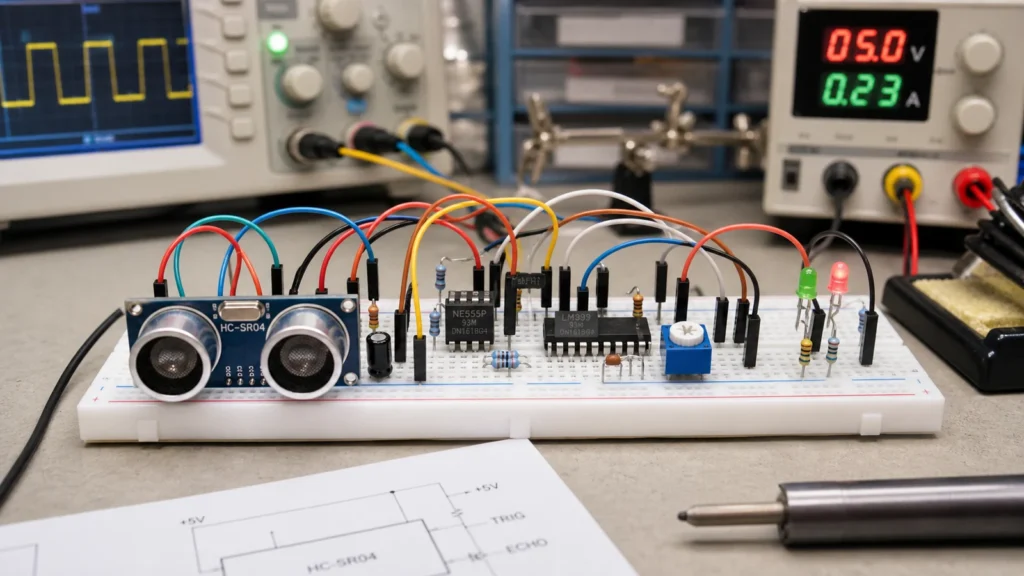
The keyword "hc-sr04 as switch no mcu schematic" usually comes from a reader who wants a distance-based trigger without writing firmware. That goal is understandable: the HC-SR04 ultrasonic module is cheap, widely available, and easy to find in hobby examples. The problem is that the module was not designed to behave like a simple on or off switch. It expects a short trigger command and then returns a pulse whose width represents echo time. Something still has to interpret that timing before a relay, transistor, LED, buzzer, or logic input can be driven reliably.
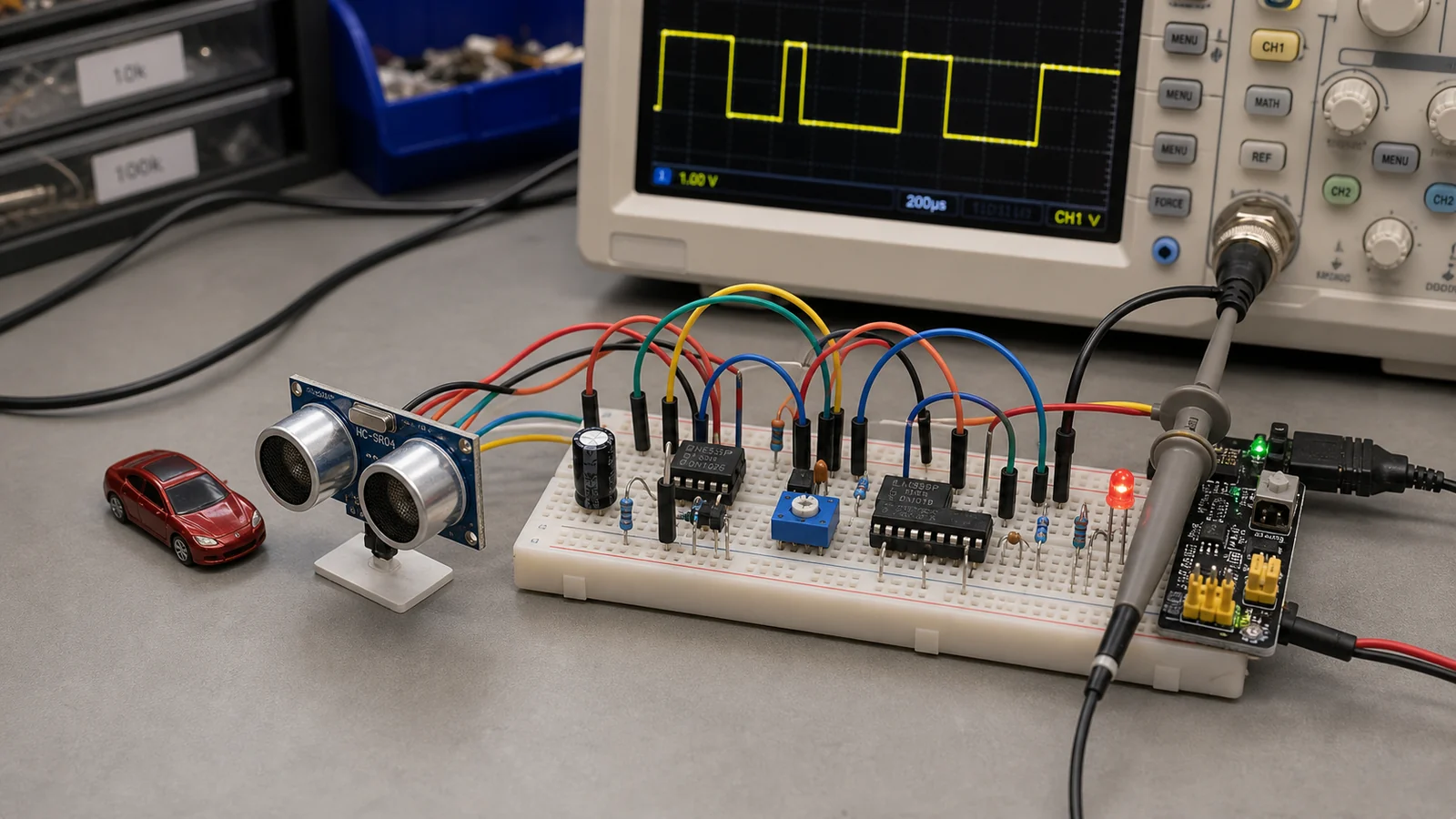
That is why the right answer is not "yes" or "no" but "yes, with extra timing and decision circuitry, and often with more complication than the idea first suggests." A publishable technical article on this topic has to be honest about those limits. Without that honesty, readers end up copying a schematic that oscillates, chatters, or fails when the target surface changes.
What the HC-SR04 actually outputs
The HC-SR04 has four familiar pins: VCC, Trig, Echo, and GND. The Trig input needs a short command pulse. After the module sends its ultrasonic burst and waits for the return, the Echo output goes high for a duration proportional to the measured distance. In other words, the module does not say "object present" directly. It says "here is a pulse width that represents time of flight."
That one detail changes the whole schematic strategy. A switch-like output requires at least four functions: a trigger pulse source, a way to capture or convert the Echo timing, a threshold decision block, and a conditioned output stage. A microcontroller does all four in code, which is why many HC-SR04 articles and tutorials assume one. If you are reviewing sensor symbols or wiring around the module, the existing ReversePCB piece on HC-SR04 ultrasonic sensor modules is useful background, but it does not solve the no-MCU switching problem by itself.
What a no-MCU schematic really needs
The smallest honest architecture usually starts with a trigger oscillator. A 555 timer or a logic monostable can generate periodic trigger pulses so the module keeps taking measurements. The Echo signal then has to be translated into something a comparator can evaluate. One route is pulse-to-voltage conversion, where Echo width charges a capacitor through a controlled path and the resulting voltage is compared against a reference. Another route is to gate a clock into a counter while Echo is high, then decode the count. Both approaches are more involved than a simple sensor board plus transistor.
Once that conversion exists, the design still needs hysteresis. Without hysteresis, the output can chatter when a target hovers near the threshold distance or when the reflected ultrasonic energy varies with angle and surface texture. A Schmitt trigger or comparator with positive feedback is usually part of a credible schematic. This is a classic case where understanding how to read electrical schematics at the block level matters more than copying a single symbol for symbol diagram.
Why simple "Echo to transistor" schematics are misleading
A common beginner instinct is to connect Echo to a transistor stage and treat any pulse as detection. That does not produce distance-based switching. It only proves that the module is active and seeing some echo event. The output pulse width changes with distance, but the transistor itself does not know what width should mean "turn on" or "stay off." The result is often a circuit that responds inconsistently or stays active across a broad and useless range.
Another weak approach is to stretch the Echo pulse with an RC network and hope the threshold becomes stable enough. That can make an indicator blink more visibly, but it does not guarantee repeatable switching. Surface reflectivity, ambient acoustic conditions, power noise, and target motion all disturb the pulse timing. Without a proper timing reference and comparator, the circuit can seem to work at one distance on the bench and fail completely in a real enclosure or room.
A practical block diagram that can work
If the goal is a genuine no-MCU design, a practical block sequence is:
- periodic trigger generator
- HC-SR04 module
- Echo pulse conditioner
- pulse-width-to-voltage or pulse-count converter
- comparator with hysteresis
- output driver for LED, transistor, relay, or logic input
This is the point where many designers realize the "no MCU" rule may be costing more complexity than it saves. By the time you add a stable trigger source, timing conversion, threshold setting, and output hold logic, the circuit is often larger and less flexible than a tiny microcontroller or a dedicated sensor-processing IC. If a relay output is required, remember that the output driver stage still needs the same protection and coil-drive discipline discussed in other relay-focused ReversePCB articles such as Reading a G3MB-202P Solid-State Relay Schematic Before You Switch AC Loads.
When a no-MCU approach is still justified
There are a few cases where the no-MCU approach makes sense. A trainer circuit, a logic-design exercise, or a product environment that already uses analog timing blocks may justify it. It can also be acceptable when the threshold is loose and the consequences of false switching are minor, such as an educational indicator or a novelty installation. In those cases, a carefully tuned comparator-based design may be enough.
But for products that need dependable switching, target discrimination, or low field-failure risk, the no-MCU route is usually the wrong optimization. A tiny controller can add averaging, timeout handling, blanking intervals, calibration options, and output debouncing with less board area than a collection of discrete timing parts. That is not marketing hype; it is simply a more direct fit to the type of signal the HC-SR04 provides.
Better alternatives for simple switching jobs
This topic becomes much clearer when the real requirement is separated from the chosen sensor. If the requirement is just "turn on when something is near," an HC-SR04 may be the wrong front end. Infrared reflective sensors, break-beam sensors, PIR modules, capacitive touch circuits, Hall switches, or industrial proximity sensors can all provide cleaner switching behavior with far less signal conditioning. The best schematic starts with the actual need, not with a module that happened to be popular in search results.
From a PCB perspective, simpler sensors also reduce routing complexity. You may not need a free-running trigger oscillator, timing capacitor with tight leakage control, or a sensitive comparator reference network. That in turn makes layout, assembly, and repair easier. General PCB assembly and troubleshooting decisions are always easier when the sensing architecture itself is simpler.
Design cautions if you still build it
If you still choose the HC-SR04 no-MCU route, verify supply stability first. Noise on the module supply or reference threshold can move the switching point around. Keep the timing-conversion capacitor away from noisy switching currents, provide a predictable ground return, and separate the output-driver current loop from the most sensitive analog reference area. Add hysteresis deliberately, not accidentally. Finally, test against different target materials and angles, because cloth, foam, glossy plastic, and hard flat surfaces reflect very differently.
Bottom line
An HC-SR04 can be made to behave like a switch without a microcontroller, but only by adding external timing, threshold, and output-conditioning blocks that replace what firmware usually does. That makes the concept technically possible but often economically and electrically awkward. A credible schematic must show how Echo pulse width becomes a stable decision, not merely how the module is powered. If the application only needs a clean near or far switch, choosing a sensor that already speaks the right electrical language is usually the better engineering decision.
Can the HC-SR04 directly replace a mechanical switch?
No. The module outputs a timed pulse related to distance, not a simple on or off contact. External logic is needed to decide when that pulse should count as a switching event.
Why do many HC-SR04 projects use a microcontroller?
A microcontroller makes it easy to create the trigger pulse, measure Echo width, filter unstable readings, and add hysteresis so the output does not chatter near the distance threshold.
Is a no-MCU HC-SR04 schematic impossible?
It is possible, but it is more complex than many readers expect. Monostables, counters, pulse-to-voltage conversion, comparators, and output latching may all be required.
What is a safer alternative if only presence switching is needed?
For many simple presence-detect jobs, an IR sensor, photoelectric sensor, PIR module, or a dedicated industrial proximity sensor is easier to wire and more reliable than forcing an HC-SR04 into a switch role.