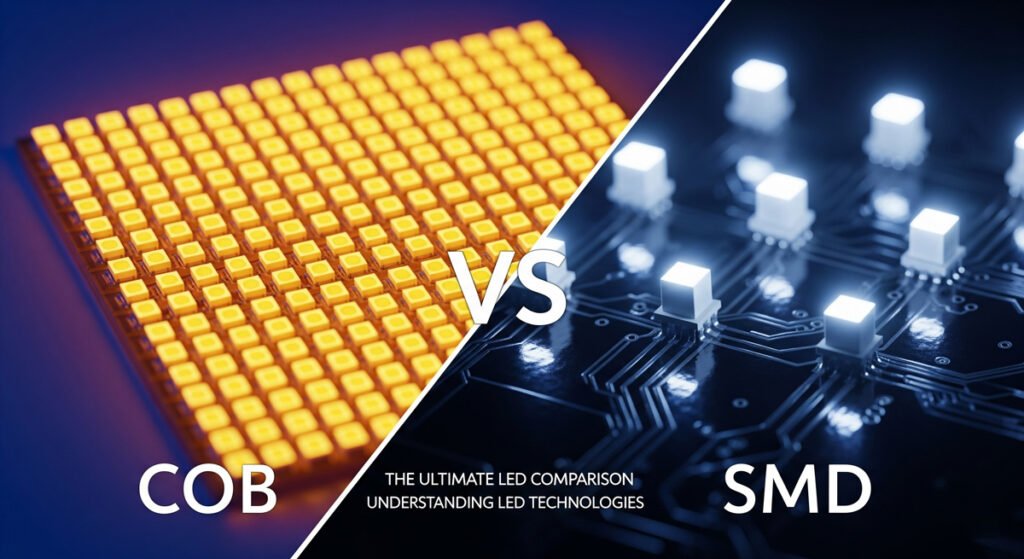
An interactive guide to understanding the two dominant LED technologies. Discover the key differences in performance and design to choose the perfect lighting for your needs.
COB vs. SMD LEDs
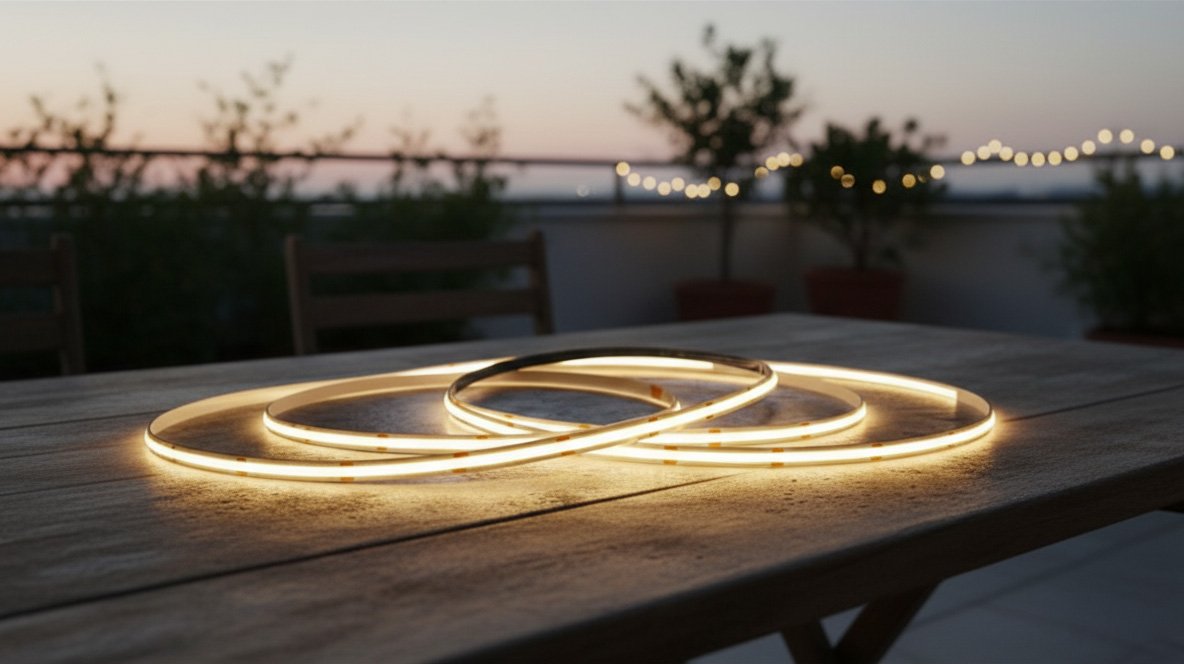
The most immediate way to distinguish between COB and SMD is by their light appearance. Hover over the strips below to see the "dotless" glow of COB versus the "individual dots" effect of SMD.
COB (Chip on Board)
A single, continuous, and uniform light source. Ideal for a seamless, high-end look.
SMD (Surface Mounted Device)
A series of distinct light dots. Often requires a diffuser for a smooth appearance.
A Deeper Dive: Performance Metrics
Beyond appearances, COB and SMD differ significantly in key performance areas. Select a metric below to compare them and see how their architecture impacts the outcome.
Energy Efficiency
COB's high-density chip design allows it to produce more light per watt, making it significantly more energy-efficient. This results in brighter light output and long-term energy savings, justifying its higher initial cost.
Choosing the Right Technology
The best choice depends entirely on your project's needs. This section provides recommendations based on the strengths of each technology.
Choose COB LEDs when...
- ✨A "dotless" look is crucial: For under-cabinet lighting, coves, or any linear light where uniform brightness is desired.
- 💡High brightness is a priority: For industrial fixtures, spotlights, and streetlights requiring maximum lumen output from a compact source.
- 🌍Energy efficiency matters: For applications where long-term energy savings and low operating costs are key factors.
Choose SMD LEDs when...
- 🎨Color changing (RGB) is needed: SMD is the go-to option for dynamic, multi-colored lighting effects in decorative applications.
- 🎯Focused light is required: For task lighting or directional spotlights where a narrower, more concentrated beam is needed.
- 💲Budget is the primary concern: SMD offers a more cost-effective solution for general-purpose LED lighting without a large upfront investment.
COB vs SMD LEDs by Beam, Thermal Density, and Service Strategy
A useful COB vs SMD comparison starts with the luminaire requirement, not a claim that one package is universally brighter or more efficient. COB concentrates many dies into one light-emitting surface, which can simplify a single reflector and produce high flux density, but it also concentrates heat and makes source replacement less granular. SMD packages distribute light, heat, and electrical connections across a board, enabling flexible layouts, color mixing, segmented control, and replacement of smaller assemblies, while adding more package interfaces and optical sources. Efficacy, glare, beam quality, color consistency, lifetime, cost, and repairability must be measured in complete products at equal delivered light and realistic temperature.
- Required light-emitting surface: compare source size, beam angle, reflector depth, lens availability, luminance, glare limit, and target illuminance.
- Package heat-density tradeoff: model junction-to-board paths, spreading area, interface materials, heat-sink mass, airflow, and hot-spot risk.
- Optical and color control: evaluate binning, CCT and CRI consistency, shadow quality, multi-channel mixing, dimming floor, and flicker.
- Assembly and field service: compare board complexity, solder process, replaceable unit, inventory, failure isolation, repair tools, and downtime.
- Equal-output comparison test: measure input power, stabilized lumens, case temperatures, beam distribution, color shift, and aging under the same duty.