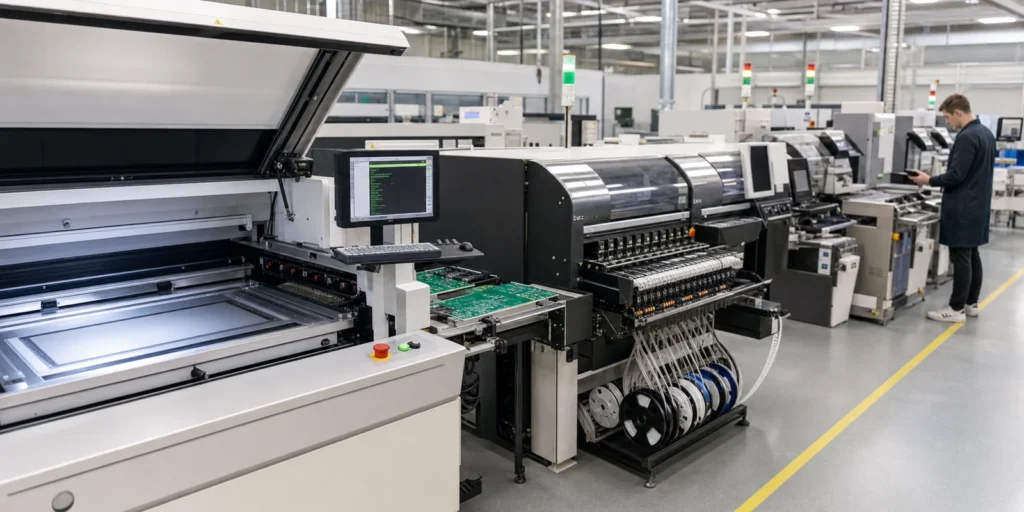
A PCB assembly machine is not one single box. In real production, it means a chain of machines that print solder paste, place parts, reflow solder joints, inspect the board, and verify that the finished assembly behaves the way the design team expected. Engineers, sourcing managers, and production planners often use the phrase loosely, but the buying decision becomes much clearer when you break the line down by function instead of asking for a generic PCBA machine.
That distinction matters because the wrong line balance causes problems long before a board reaches final test. A fast pick-and-place cannot rescue a weak stencil printer. A well-profiled reflow oven cannot fix poor feeder setup. An AOI system cannot prevent a defect that the process keeps generating every shift. If your goal is stable yield, shorter changeovers, or enough capacity for a new product family, you need to understand which machines actually control risk.
For teams comparing suppliers or preparing a line expansion, the better question is this: which machine functions are critical for your board mix, component density, lot size, and quality target? That is where the engineering value sits.
Start with the sequence, not the machine catalog
A typical SMT line follows a practical order. Boards are loaded, solder paste is printed through a stencil, components are placed, solder joints are formed in reflow, and then the assembly moves through inspection and testing. Through-hole insertion, selective soldering, conformal coating, depaneling, or functional test may follow depending on the product.
When someone searches for a PCB assembly machine, they are usually looking for one of three things:
- a broad explanation of the machines used in a line,
- help choosing equipment for a new assembly process, or
- a way to compare supplier capabilities without getting lost in marketing claims.
Those needs are related, but they are not identical. A prototype-focused line values flexibility and quick setup. A lighting or appliance line may care more about throughput and repeated product families. A dense industrial control board with fine-pitch parts may prioritize print repeatability, placement vision, and traceable inspection data over raw parts-per-hour.
Which machines usually matter most?
1. Stencil printer
The stencil printer is often the most underestimated machine in the line. Yet many assembly defects start here. Too much paste, too little paste, poor release, smeared apertures, or unstable board support can all create downstream defects that look like placement or oven problems. In practice, fine-pitch devices, bottom-terminated parts, and mixed-technology boards quickly expose any weakness in print control.
Engineers evaluating a printer should care about board clamping, understencil cleaning control, fiducial recognition, paste roll stability, and how easily the machine handles different product thicknesses. If you already rely on solder paste inspection, the printer should also support a feedback loop instead of functioning as an isolated station.
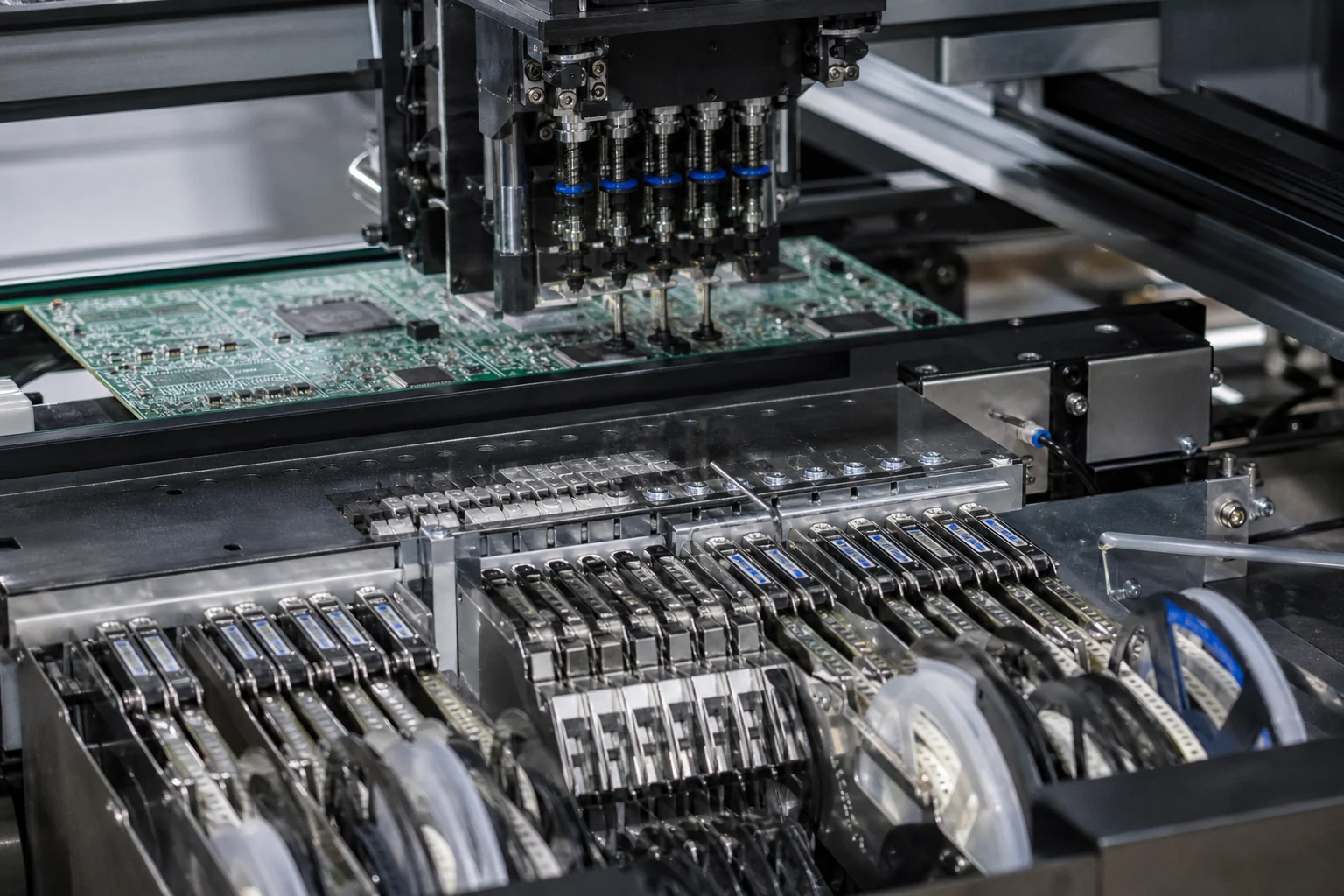
2. Pick-and-place machine
The pick-and-place machine gets most of the attention because it is easy to compare speed numbers. But high quoted placement rates can be misleading. Real output depends on feeder count, nozzle change behavior, package variety, vision alignment, board handling time, and how often the line stops because a setup detail was missed.
For a high-mix environment, feeder management and offline programming discipline matter as much as theoretical speed. For a stable high-volume product, placement rate and head architecture matter more. The best question is not “How fast is it?” but “How much of that speed survives my actual component library and changeover pattern?”
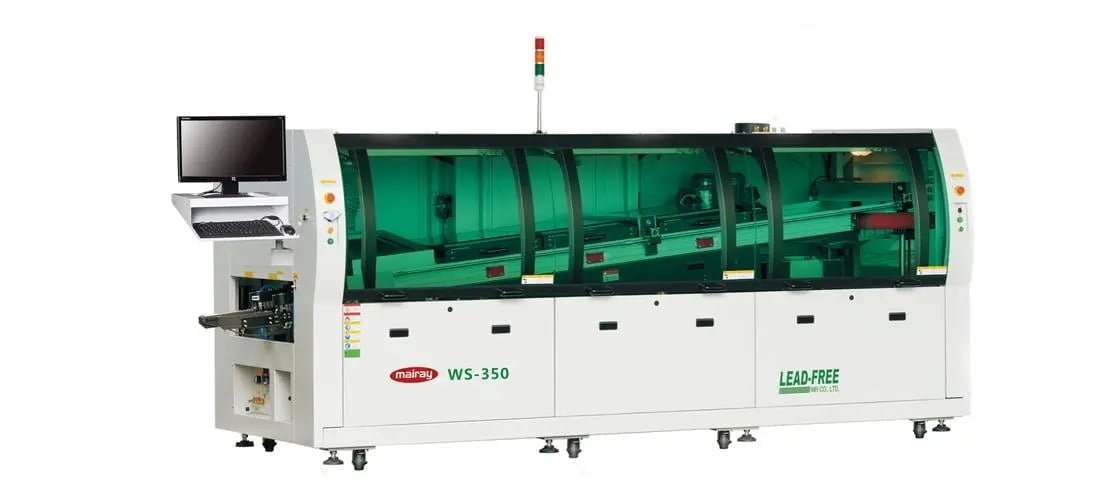
3. Reflow oven
The oven turns deposited paste and placed components into real solder joints. Temperature uniformity, atmosphere control when needed, conveyor stability, and recipe repeatability all affect wetting, voiding, tombstoning risk, and component stress. A capable oven also makes process transfer easier when a product moves from pilot lots to full production.
If the board uses large thermal masses, mixed component heights, or heat-sensitive parts, oven profiling becomes a major engineering checkpoint. A line that looks balanced on paper can still bottleneck here if recipe tuning is difficult or profiling takes too long for frequent product changes.
4. AOI, AXI, and test stations
Inspection does not create quality, but it tells you whether the process is staying in control. AOI is usually the first inspection layer after reflow. AXI becomes more attractive when hidden joints, bottom-terminated packages, or dense solder coverage make optical verification incomplete. Functional test or in-circuit test matters when the cost of an escaped failure is high or when simple visual conformity is not enough.
For many teams, this is where supplier evaluation becomes practical. A vendor can claim advanced equipment, but if their data flow, repair loop, and defect feedback are weak, the machine list alone does not translate into reliable output.
How to judge whether a line is well matched to your product
Look at your board family before you look at brand names. Fine-pitch BGAs, bottom-terminated packages, odd-form parts, flexible substrates, and tall connectors create very different line demands. A low-cost machine set that works for simple consumer boards may become unstable on industrial or automotive-style assemblies with tighter process windows.
Useful selection questions include:
- How much setup time is required between jobs?
- Can the line support both prototype and repeat production without constant compromise?
- What inspection data is available for root-cause work?
- Which station is the real bottleneck at target volume?
- How dependent is output quality on one especially skilled operator?
That last point is important. A process that only runs well when one senior technician is present is not truly stable capacity.
What buyers and engineers should verify with a supplier
If you are not buying machines yourself but are choosing an assembly partner, ask for the line logic, not just a capability list. You want to know how they print, place, inspect, profile, and test boards like yours. Ask about feeder verification, first-article approval, profile ownership, and defect feedback from inspection back to process settings.
It also helps to map the supplier’s equipment to your risk points. A power board with large copper areas may need stronger thermal process control than a simple control board. A communications product with dense fine-pitch parts may need stronger placement vision and inspection traceability. A medical or industrial board may justify deeper test coverage even if visual appearance is clean.
ReversePCB readers often think in terms of manufacturability rather than machine glamour. That is the right instinct. The best line is the one that repeatedly produces good boards with a controlled process window, clear traceability, and realistic changeover discipline.
When one “PCB assembly machine” is not enough
For some searches, users hope there is a single machine that can cover the whole job. In reality, even compact desktop systems are still a compromise around product size, package range, and throughput. A one-box answer can work for lab builds or narrow product classes, but it is rarely the long-term answer for commercial production.
That is why understanding the full sequence is more useful than chasing a generic keyword. Once you know where defects originate and where capacity really disappears, it becomes easier to decide whether you need a printer upgrade, another placement head, better oven control, stronger AOI, or simply a better setup process.
Final takeaway
A PCB assembly machine should be evaluated as part of a process chain, not as an isolated piece of hardware. The most important machines are the ones that control your actual failure modes and volume constraints. For one board family, that may be the stencil printer and SPI feedback loop. For another, it may be placement flexibility, oven repeatability, or test coverage. The correct choice is always tied to product mix, defect risk, and how disciplined the line is from setup through verification.
FAQ
What is the most important PCB assembly machine in an SMT line?
There is no universal single machine, but the stencil printer is often the most process-critical because many downstream defects start with unstable solder paste deposition.
Is a pick-and-place machine the same as a PCB assembly machine?
Not exactly. A pick-and-place machine is one station in the broader PCB assembly machine chain, which also includes printing, reflow, inspection, and testing equipment.
How should I compare suppliers that claim advanced SMT equipment?
Ask how their machines are used on boards like yours, including print control, feeder verification, reflow profiling, inspection feedback, and test coverage. A machine list alone does not prove process control.