Finding a schematic symbol for a light bulb sounds straightforward, but in practice, it usually stems from one of three common challenges: identifying a symbol in an appliance or automotive diagram, tracing a lamp load in a control circuit, or determining whether a drawing represents a traditional incandescent lamp, an LED indicator, or a general lighting output.
This distinction matters because lamp symbols are frequently used as functional shorthand. They can represent an incandescent bulb, a panel indicator, a filament-based load, or a lighting element whose exact physical implementation is detailed elsewhere. Misinterpreting the symbol can easily lead to selecting the wrong replacement part, misreading the driver stage, or misjudging whether the circuit expects a purely resistive load.
Why this symbol matters more than it looks
A light bulb symbol is not only a beginner-level identification exercise. For troubleshooting and design work, it tells you where visible illumination is part of the circuit behavior. That could mean status indication, backlighting, user feedback, signal presence, or a real power-consuming lamp load.
In a repair setting, the symbol can tell you whether the output is meant to drive something that glows directly or whether it simply triggers another lighting subsystem. In a design setting, the symbol helps you reason about current draw, switching method, and whether the load is likely to be sensitive to polarity or voltage drop.
The most common light bulb symbol styles
You will not see exactly one universal lamp icon everywhere. The drawing standard, the EDA library, the age of the document, and the industry all influence how the symbol appears.
Lamp symbol in a circle
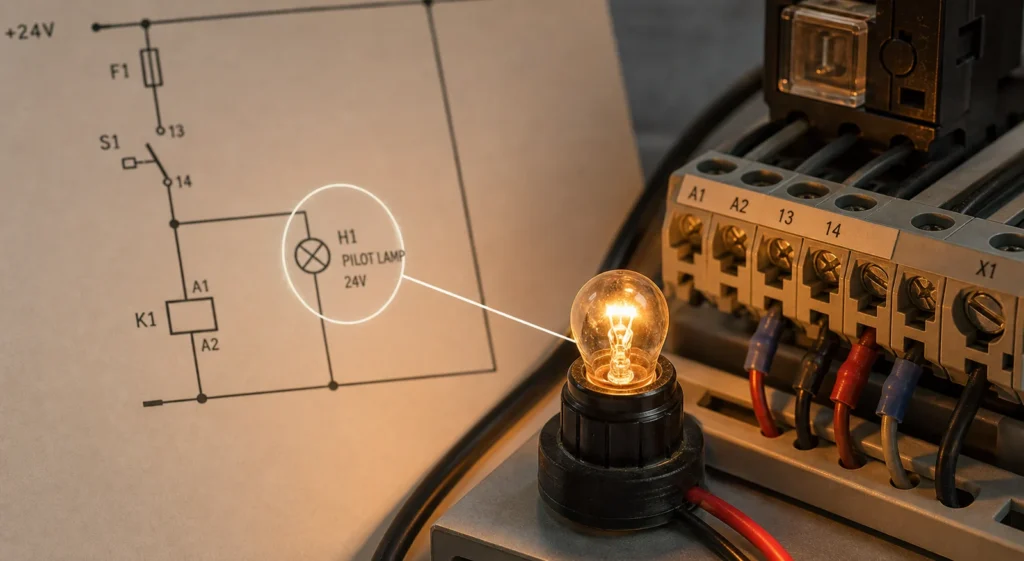
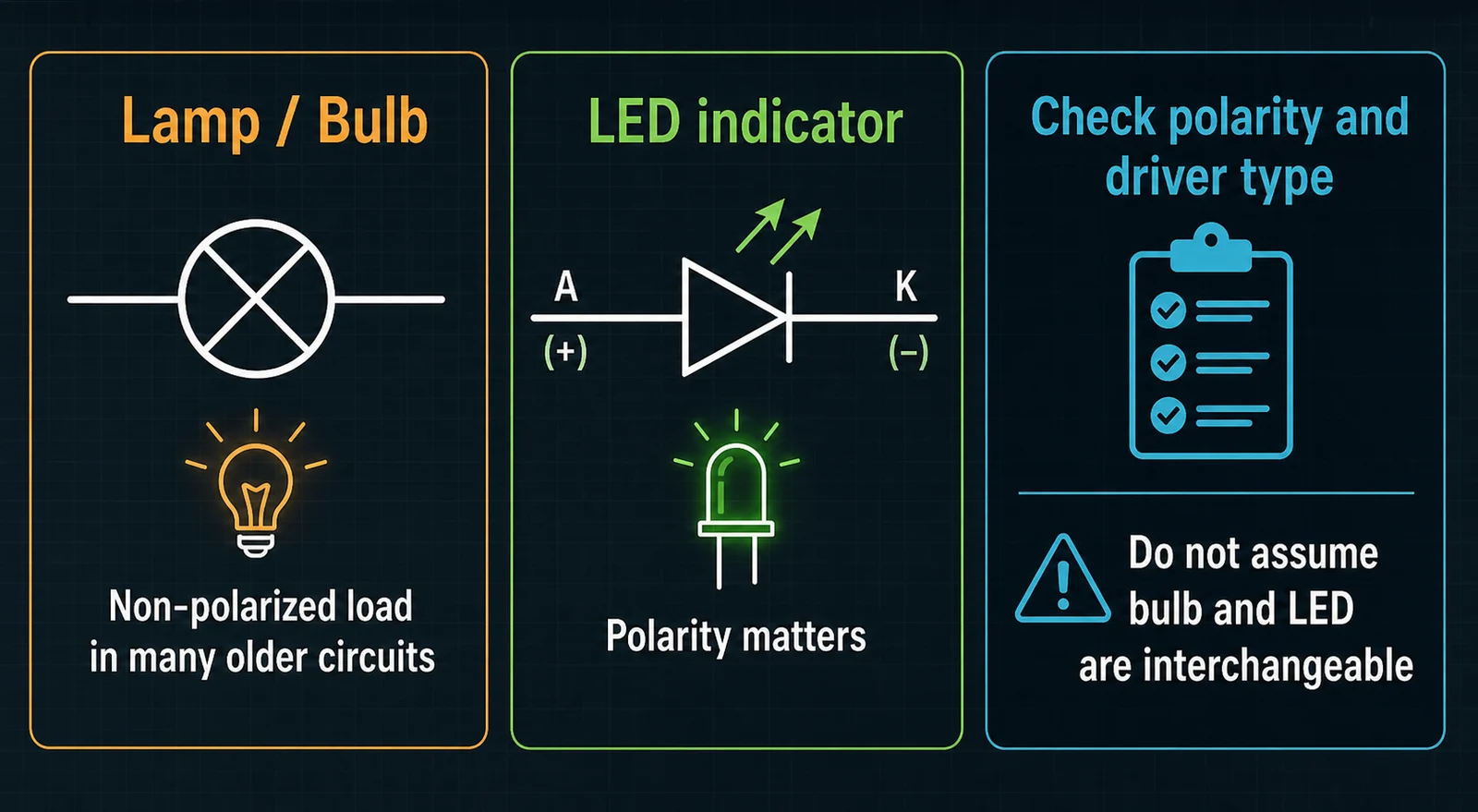
A common representation uses a circle with an internal cross or filament-like marking. This style is often seen in electrical and educational diagrams because it is easy to recognize quickly as a lamp or bulb-type load.
Simplified load-style lamp symbol
Some schematics simplify the lamp into a basic indicator or labeled load block, especially in industrial controls or service documents where clarity matters more than decorative detail. In those cases, the label such as LAMP, L1, or IND may carry more meaning than the symbol shape itself.
Panel indicator or pilot lamp notation
On control panels, machine wiring diagrams, and older equipment manuals, a lamp may be treated as a pilot light rather than a general light bulb. The symbol may look similar, but the context tells you it is intended as a status indicator rather than a room-lighting or power-lighting element.
Light bulb symbol vs LED symbol
This is the confusion that causes the most mistakes.
A classic lamp symbol often implies a filament-style or non-polarized light-emitting load. An LED symbol, by contrast, usually includes diode-style structure and outward arrows to indicate emitted light. That difference matters immediately when you are checking polarity, forward voltage, current limiting, or driver topology.
If the schematic uses a light bulb symbol, do not automatically assume the circuit was designed for an LED replacement. Many old circuits rely on the resistance and current behavior of a filament lamp. Swapping in an LED can change the way the circuit senses current, warms up, dims, or responds to transient voltage.
This issue appears often in dashboard panels, appliance indicators, and older power supplies where the lamp load is not merely decorative. It may also be part of timing, bias, or fault indication behavior.
What the symbol tells you about the circuit around it
Is the lamp in series or parallel?
A series-position lamp may be doing more than illumination. It can act as a current-limiting element, a test lamp, or a behavior-sensitive load in older analog or mains circuits. A parallel-position lamp often behaves more like an indicator or branch load that turns on when the monitored node is energized.
Is the driver transistor-side or relay-side?
If a transistor, MOSFET, or relay contact sits next to the lamp symbol, the circuit is telling you how the lamp is controlled. That helps you decide whether your fault is likely in the light source itself, the switch element, the supply rail, or the command logic.
Is it part of a PCB or a wiring harness diagram?
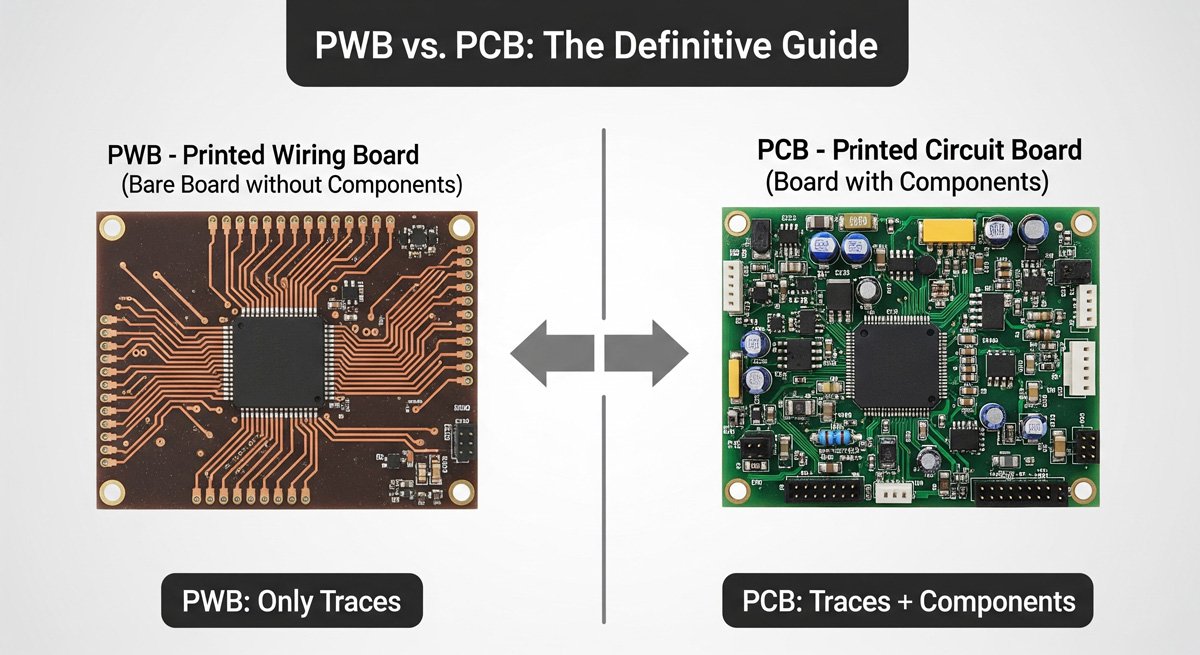
On a PCB-related schematic, a lamp symbol may point to a board-mounted indicator, backlight node, or connector-fed light assembly. In a wiring harness or appliance service sheet, the same symbol may refer to a remote bulb holder, panel lamp, or field-replaceable module. Context changes the service strategy.
If you are already using a structured method like ReversePCB’s guide on how to read electrical schematics, the lamp symbol becomes easier to place inside the power path and control path instead of treating it as an isolated icon.
Practical mistakes to avoid
Mistaking a lamp symbol for a generic load
Some simplified schematics do reduce visual detail, but if the diagram explicitly points to a lamp or indicator, assume the visual output matters to circuit behavior until proven otherwise.
Replacing a bulb with an LED without checking the circuit
This is one of the most common field mistakes. A direct LED swap can fail because of polarity, driver voltage, current limiting, dimming behavior, or because the original lamp was part of the circuit’s operating condition rather than a passive end load.
Ignoring voltage and socket details
The symbol alone rarely tells you the full replacement specification. Voltage, wattage, base style, current draw, and sometimes even thermal behavior are handled in notes, parts lists, or service documentation.
Confusing a lamp with a fuse or another round symbol in poor scans
Low-resolution manuals sometimes blur circle-based symbols. The fastest check is the surrounding function. A lamp connects into a visible load path or indicator branch. A fuse usually sits in a protective series location and is identified with an F designator. Existing symbol references such as 140 commonly used PCB markings can help when the document quality is poor.
How engineers should document lamp symbols more clearly
If you are creating schematics, do not rely on symbol art alone. Add a useful designator, note the expected lamp type or module, and make the driver relationship obvious. For example, a board-mounted status lamp and an external service-replaceable bulb should not be left equally ambiguous if the maintenance path is different.
When a circuit has been modernized from filament to LED behavior, document that clearly. Otherwise a technician reading the drawing later may assume the symbol still reflects an older lamp technology and make the wrong troubleshooting decision.
Final takeaway
The light bulb schematic symbol tells you that the circuit includes a lighting or indicator load, but the symbol alone does not define the exact technology, rating, or replacement method. To read it correctly, check whether the drawing context points to a filament lamp, pilot indicator, board-level light output, or a branch load with visual feedback.
Then compare the surrounding drive circuit, supply voltage, and designator before replacing parts or redrawing the circuit. That approach makes the symbol useful in real engineering work instead of leaving it as a memorized textbook icon.
Does a light bulb symbol always mean an incandescent bulb?
No. It usually means the circuit has a lamp or visible indicator load, but the exact implementation may still be defined elsewhere in the parts list or notes.
How is a lamp symbol different from an LED symbol?
A lamp symbol usually represents a non-polarized bulb or lamp-style load, while an LED symbol includes diode structure and light-emission arrows, which matters for polarity and drive conditions.
Can I replace a bulb with an LED if the schematic shows a lamp symbol?
Not automatically. Older circuits may rely on the current draw or resistance of a filament lamp, so an LED substitution can change how the circuit behaves.
What should I check after identifying a lamp symbol on a schematic?
Check the supply voltage, the driver stage, whether the lamp is in series or parallel, and whether the symbol refers to a panel indicator, board-level light, or remote replaceable bulb.