Addressing EEPROM functionality on the ESP32 is driven by practical data persistence needs rather than legacy memory theory. Whether preserving Wi-Fi credentials, calibration data, or system counters across reboots, engineers often encounter online examples that perpetuate outdated Arduino paradigms—implying the ESP32 contains a dedicated EEPROM block comparable to classic AVR chips.
The primary correction begins here: the ESP32 does not incorporate a separate hardware EEPROM array; instead, persistent storage relies on flash-backed mechanisms. Although EEPROM emulation libraries persist, robust engineering demands prioritizing nonvolatile flash constraints, write wear, explicit commit cycles, and proper data organization.
What “EEPROM” means on ESP32 in practical projects
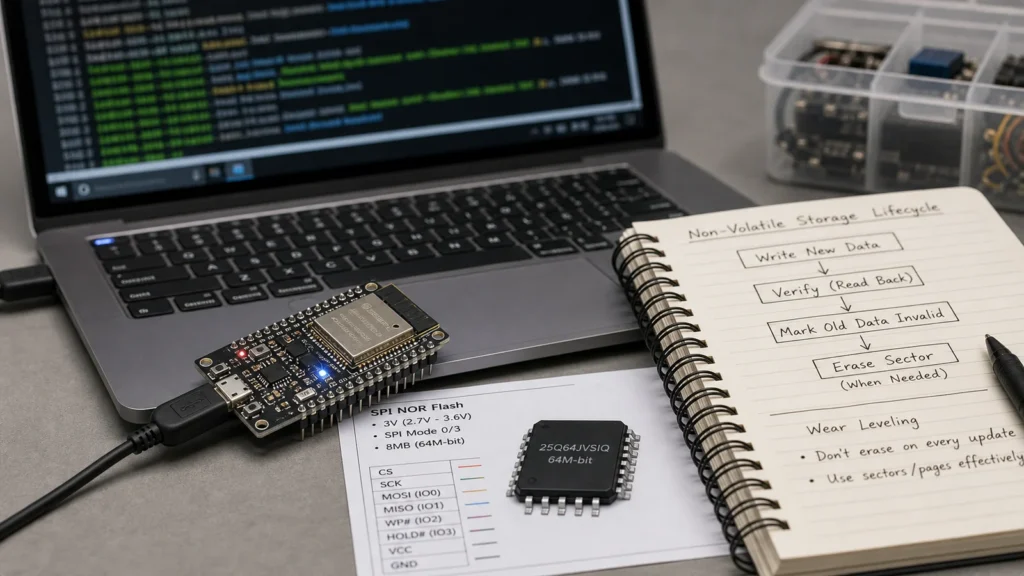
On older microcontroller platforms, EEPROM often referred to a small built-in memory region intended for settings. Many developers learned a simple pattern: write bytes, read bytes back later, and keep going. The ESP32 ecosystem changed that assumption. Persistent storage is usually backed by flash and exposed through libraries that manage sectors, wear, and key-value storage semantics.
That difference matters because flash behaves differently from byte-addressable EEPROM. You should not design an ESP32 configuration system as though every loop iteration can rewrite the same address forever. If you do, you may shorten flash life, slow your application, and create avoidable corruption risk during resets or brownouts.
Why Preferences is usually a better starting point
For many modern ESP32 projects, the Preferences API is the practical default. It stores named values in the Non-Volatile Storage system, often called NVS. This is more robust than treating persistence as a raw byte array unless you have a very specific legacy reason to do so.
Preferences makes it easier to store values by key, version your settings, and keep application logic readable. Instead of remembering that byte 17 means a boot mode and bytes 20 through 23 mean a threshold, you can store named items and update them selectively. That does not remove the need for discipline, but it reduces a category of self-inflicted bugs.
If you come from a tutorial culture that still says “use EEPROM on ESP32,” it helps to mentally translate that phrase into “store configuration safely in flash-backed nonvolatile memory.” The wording is less nostalgic, but it is much closer to what the firmware is actually doing.
When an EEPROM-style wrapper still appears in code
Some codebases use the Arduino-compatible EEPROM library on ESP32 for compatibility with older examples. That can work for small migration tasks, but it is not the best long-term abstraction for every project. The wrapper may encourage developers to think in fixed offsets and frequent commits instead of in structured records and controlled write events.
That is especially risky when a product starts as a prototype and later moves toward custom hardware. Once the firmware reaches production boards, field updates, and service cases, storage choices become part of overall reliability. ReversePCB’s broader PCB layout guidelines are about physical design, but the same principle applies in firmware architecture: make maintenance easier before the design becomes expensive to change.
Write endurance is the real design limit
The practical constraint on ESP32 persistence is not usually whether the code can compile with an EEPROM-like API. The real limit is how often you write. Flash has finite program and erase endurance. That does not mean normal settings storage is unsafe. It means you should avoid turning configuration storage into a high-rate logging mechanism.
A good pattern is to write only when a value actually changes, batch related updates when possible, and separate frequently changing runtime data from true long-term settings. If you need fast counters, event logs, or continuous measurement history, consider another storage method or a buffering strategy instead of hammering flash on every cycle.
Brownouts, resets, and power integrity still matter
Persistent storage bugs are not always software-only problems. If a board resets during a write, the firmware may leave a partially updated record or trigger a recovery path you did not test carefully. This is one reason stable power design matters even for small embedded products. On prototypes, a bench supply and jumper wires may hide issues that appear later on a finished board or battery-powered assembly.
When the application depends on stored credentials or calibration, it is worth validating behavior through unexpected resets, low-voltage events, and firmware migration. That test mentality belongs with the rest of embedded bring-up. If your design also includes radios, sensors, or multiple power domains, treat storage validation as part of the complete printed circuit board system, not as an isolated library call.
How to structure settings so future updates do not break them
Store values with intent, not just with convenience. Add version markers when the format may evolve. Keep service-only values separate from user-editable configuration. Validate ranges on boot instead of assuming stored data is always sane. If a firmware update changes the meaning of a field, migrate it explicitly rather than hoping the old bytes still make sense.
This is where named storage pays off. It becomes much easier to add a new configuration item, retire an old one, or recover defaults selectively. The more your project behaves like a product instead of a one-off demo, the more important these habits become.
Common mistakes when using ESP32 persistence
The first mistake is calling it EEPROM and then designing as though it were physically identical to AVR EEPROM. The second is writing far too often because a loop or UI event triggers commits more than expected. The third is failing to define what should happen when stored data is missing, corrupted, or from an older firmware version.
Another mistake is mixing secrets, user settings, calibration values, and debug flags into one undefined blob. That may seem fast at the beginning, but it becomes fragile when you need field support or have to explain failures after deployment.
When to choose something other than internal flash-backed storage
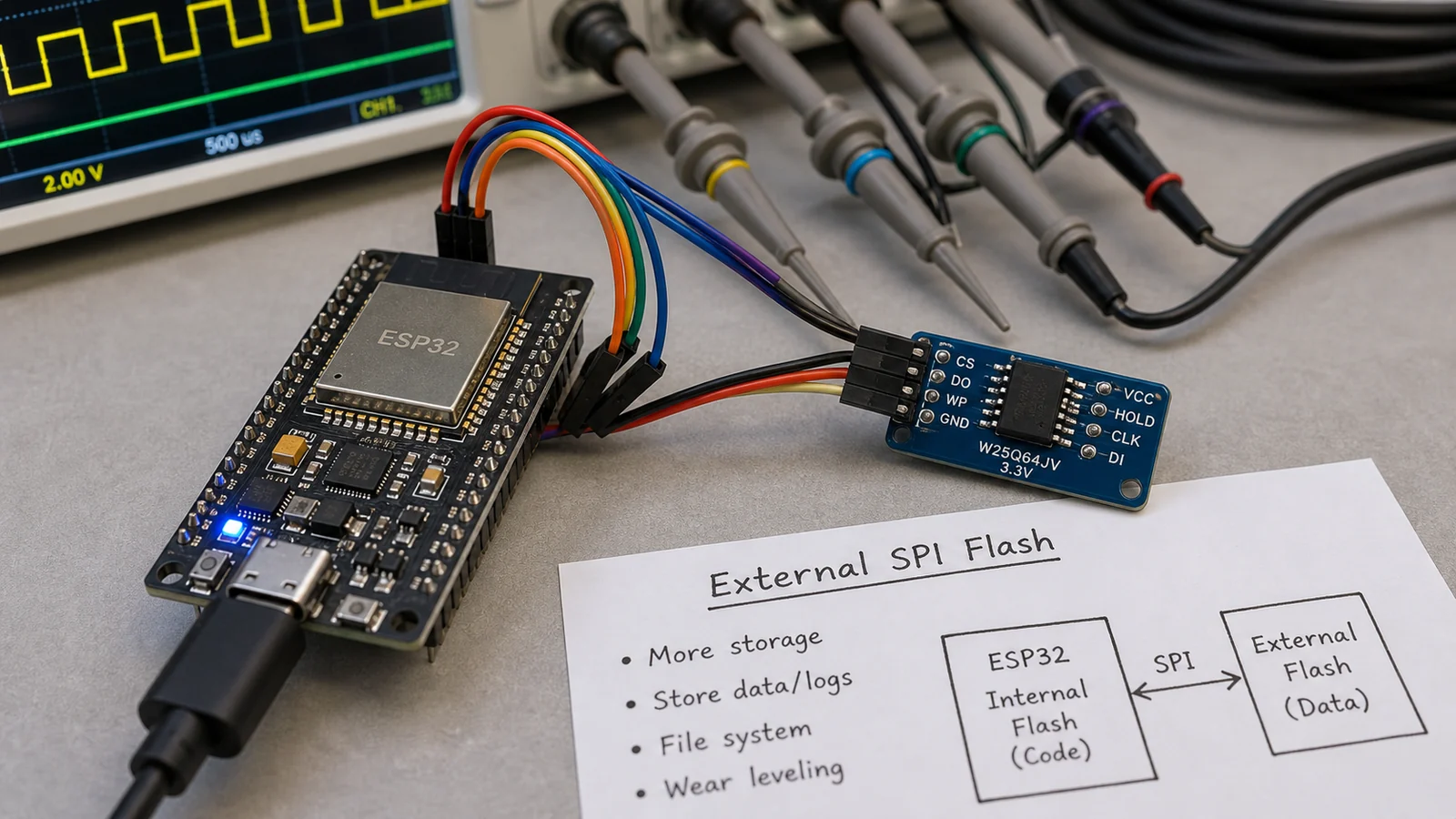
If your device needs frequent high-volume writes, heavy logging, or structured files, internal flash-backed settings storage may not be the best fit by itself. External FRAM, external flash, SD storage, or a more deliberate data-logging architecture may be better choices depending on the duty cycle and retention needs.
The right answer depends on the product. A sensor node that updates a threshold once a week has different needs from a gateway that records events every second. Treat storage design as a system decision, not as a copy-paste snippet from a board tutorial.
Final takeaway
Using EEPROM on ESP32 is really about using flash-backed nonvolatile storage responsibly. If you think in terms of Preferences, NVS, write endurance, power stability, and versioned settings, your design decisions become much better than if you simply imitate older byte-address examples.
For small configuration data, the ESP32 is perfectly capable. The key is to write less often, organize settings clearly, and test resets and upgrades before the firmware reaches hardware you care about supporting in the field.
Does the ESP32 have real hardware EEPROM like many AVR boards?
Not in the usual AVR sense. ESP32 persistence is typically handled through flash-backed storage such as NVS, even when an EEPROM-style library wrapper is used in Arduino examples.
Should I use Preferences or an EEPROM-style library on ESP32?
For most modern projects, Preferences is the cleaner starting point because it works with named values and better reflects how ESP32 nonvolatile storage is organized.
Can writing settings too often wear out ESP32 flash?
Yes. Flash has finite endurance, so configuration values should be written only when necessary rather than continuously in a fast loop.
What should I test before trusting ESP32 stored settings in a product?
Test power-loss behavior, unexpected resets, default recovery, range validation, and migration between firmware versions so you know the device can recover from real-world conditions.