About STM32C0
The STM32C0 series microcontroller is a low-power, high-performance microcontroller product launched by STMicroelectronics. They are designed for applications that require small size, low power consumption, and high integrability, such as sensors, consumer products, battery-operated devices, home automation, and security. This series of microcontrollers uses the ARM Cortex-M0 core and has rich peripherals.
STM32C0 Features
The STM32C0 series MCU has simple peripherals and a mature ecosystem, making it very suitable for engineers to develop. Compared with similar products on the market, STM32C0 has more powerful performance, reliable quality and stability.
High Performance
STM32C0 provides users with reliable chip performance:
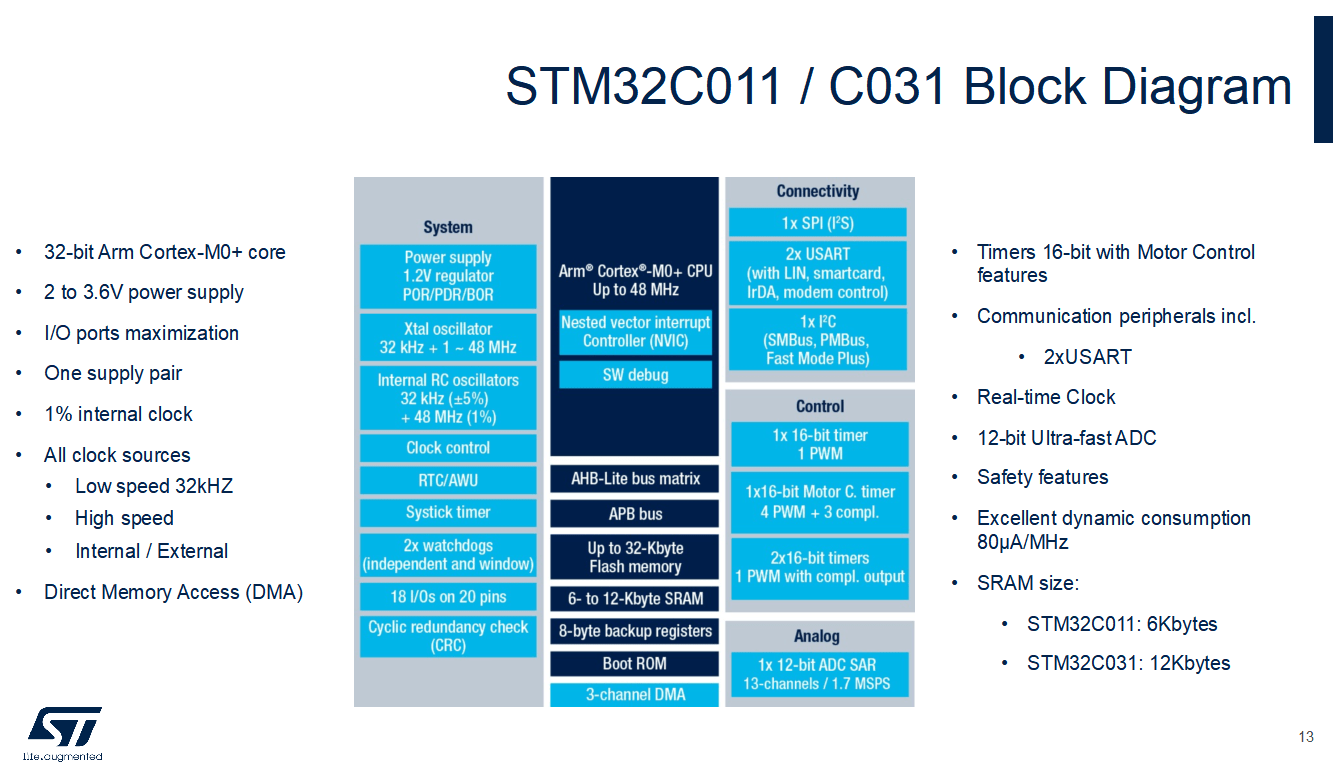
- 32-bit Arm Cortex-M0+ core
- 2-3.6V power supply
- Maximize I/O ports
- A pair of power packs
- 1% internal clock
- All clock sources
- Low speed 32kHz
- High speed
- Inside/outside
- Direct memory access (DMA)
- 16-bit timer with motor control function
- Communication peripherals include 2 USART
- Real Time Clock
- 12-bit ultra-fast ADC
- Security function
- Excellent dynamic consumption 80μA/MHz
Cost-effective
ST’s official price for the STM32C0 is no more than $1, making it the most cost-effective STM32 MCU. The reasons for the low price of STM32C0 include:
- fewer peripheral components to achieve smaller PCB size;
- equipped with only 1 pair of power supplies;
- high-precision embedded high-speed clock.
Low Power Consumption
STM32C0 has a simple low-power architecture, arranged from high to low power consumption, with operating modes such as running, sleep, stop, standby and shutdown. Take STM32C031x4/x6 as an example (in Typ 25°C):
- Operating mode: at least 37.5μA/MHz
- Sleep mode: at least 0.0745mA;
- Stop mode: at least 70.5µA;
- Standby mode: at least 6.75µA;
- Shutdown mode: at least 9.00nA;
Since the HSI startup time and default startup frequency is 12MHz, while STM32G0 is 16MHz, the wake-up time on STM32C0 is longer than that on STM32G0.
Compact Package
STM32C0 provides 9 micro packages, from the smallest SO8N to the largest LQFP48, from 8pin to 48pin, while the number of pins of ordinary MCUs rarely reaches less than 20pin.
- Micro package:
3x3mm 20pin-QFN, 28/32/48-pin UFQFPN - Smallest size:
1.42 x 2.08mm WLCSP12 - Popular use:
SO8N, TSSOP20, LQFP32/48
Compatible with STM32G0 series
The STM32C0 series uses the same 90nm technology as STM32G0 to ensure high-quality performance standards and ensure that users can easily migrate to STM32G0. The pins consistent with STM32G0 leave room for future product upgrades.
- Based on Arm Cortex-M0+ core, clocked at 48MHz;
- Delivers 44DMIPS instruction throughput and 114CoreMark performance;
- Has the same pin layout as the STM32G0 series;
STM32C0 Block Diagram
STM32C0 Pinout Configuration
Both the STM32C011 and STM32C031 series have only one power supply pin (VDD/VSS), so the layout of the STM32C0 series microcontroller becomes simpler. In packages smaller than 48 pins, the HSE and LSE pins are multiplexed and we can select through the “HSE_NOT_REMAPPED” bit in the option byte.
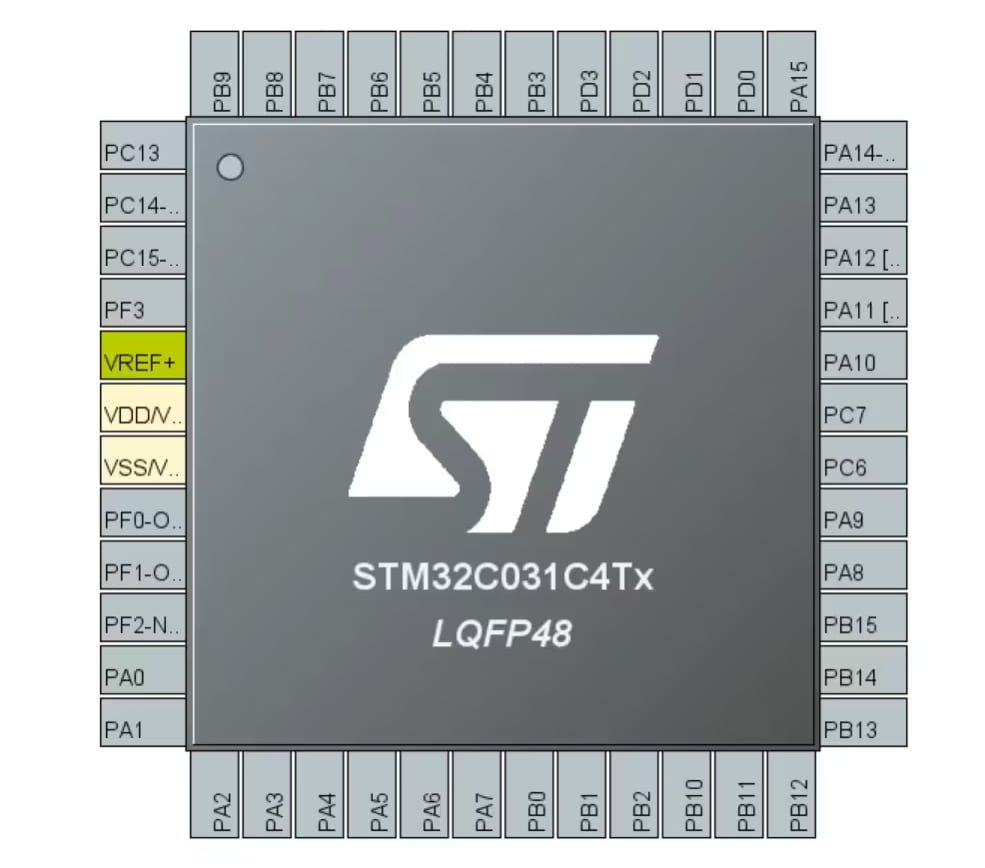
STM32C0 Application
- Smart home products: such as refrigerators, ovens, coffee machines, etc;
- Industrial equipment: such as industrial pumps, fan controls, circuit breakers, smoke detectors, fire detectors, alarm devices, etc;
- Consumer electronic equipment: such as computer peripherals, e-cigarettes, other accessories, etc.
Cost-Down Checklist for an STM32C0 Design
An STM32C0 is a low-cost 32-bit microcontroller only when the complete board and firmware remain inside its resource envelope. Compare exact derivatives by usable pins and peripherals, not by the family headline, and include assembly, external components, test time, and migration effort in the cost decision. Prototype with the smallest candidate and one resource step above it. Accept the lower-cost device only after two clean builds pass maximum interrupt load, memory watermark, cold start, brownout, and peripheral concurrency tests.
- Memory margin: build production firmware with the real linker options, bootloader, diagnostics, and update reserve; check both Flash and worst-case stack plus heap use.
- Pin budget: map power, reset, SWD, oscillator, analog, and alternate functions before selecting the smallest package, including pins unavailable to the application.
- Peripheral fit: verify the required ADC channels, timer modes, UART, SPI, I²C, DMA behavior, and interrupt sharing on the exact part.
- External BOM: count crystals, level shifters, analog amplifiers, supervisors, and memory that a cheaper MCU may force onto the board.
- Production risk: retain debug access, confirm programming time and option-byte flow, and qualify voltage, temperature, wake-up, and clock tolerances.
STM32C0 Series of ICs Unlock
- STM32C011D4M6
- STM32C011D4M7
- STM32C011D4P3
- STM32C011D4P6
- STM32C011D4P7
- STM32C011D4U3
- STM32C011D4U6
- STM32C011D4U7
- STM32C031C6T6
- STM32C031C6T7
- STM32C031G6U6
- STM32C031C6U6
- STM32C031F6P6