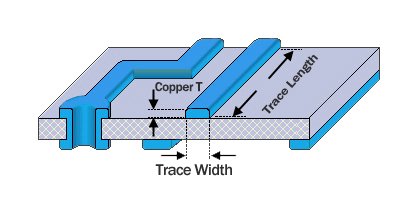
1. Pilih Tipe Jalur (Trace)
2. Masukkan Parameter
mils
mils
mils
mils
Diagram Microstrip
Rumus
Diagram Stripline
Rumus
Diagram Coupled Microstrip
Rumus
Diagram Coupled Stripline
Rumus
3. Hasil Kalkulasi
Impedansi Karakteristik (Zo)-- Ω
Impedansi Diferensial (Zdiff)-- Ω
Penafian: Kalkulasi ini hanya untuk tujuan estimasi. Untuk desain akhir, selalu gunakan perangkat lunak simulasi profesional.
Input impedansi dan hasil pemeriksaan kewarasan
Perkiraan impedansi PCB hanya dapat diandalkan seperti geometri dan input materialnya. Gunakan dimensi dari stackup yang sudah jadi, bukan karya seni nominal atau prepreg yang tidak ditekan. Simpan setiap panjang dalam satu unit sistem dan pilih struktur yang benar, karena microstrip dan stripline menggunakan distribusi bidang yang berbeda.
- geometri:Masukkan lebar dan ketebalan jejak yang sudah selesai ditambah tinggi dielektrik ke bidang referensi yang relevan; Untuk pasangan diferensial, sertakan spasi edge-to-edge.
- Bahan:Gunakan konstanta dielektrik laminasi yang berlaku pada frekuensi operasi, bukan nilai FR-4 generik.
- Batas model:Masker solder, kekasaran tembaga, etsa trapesium, tembaga di dekatnya, dan tenunan dapat menggeser hasilnya jika model yang dipilih menghilangkannya.
- Interpretasi:Perlakukan hasilnya sebagai perkiraan desain. Minta fabrikator untuk menyesuaikan geometri produksi dan memverifikasi impedansi terkontrol dengan pemecah lapangan yang sesuai dan kupon uji.
Panduan Penggunaan
- Pilih Jenis
Jalur Pilih salah satu dari empat konfigurasi jalur dengan ikon visual:- Microstrip: Jalur tunggal pada lapisan luar di atas bidang ground.
- Stripline: Jalur tertanam di antara dua bidang ground.
- Microstrip Terhubung Tepi: Pasangan diferensial pada lapisan luar.
- Stripline Terhubung Tepi: Pasangan diferensial tertanam di antara bidang ground.
- Masukkan Parameter
- Konstanta Dielektrik (εr): Permittivitas listrik bahan (misalnya, 4,4 untuk FR-4).
- Ketebalan Jalur (T): Ketebalan tembaga dalam mil (1 oz = 1,37 mil).
- Lebar Jalur (W): Lebar konduktor dalam mil.
- Tinggi Substrat (H)/Jarak Antar-Plane (B): Jarak ke plane ground.
- Jarak Jalur (S): Muncul untuk pasangan diferensial; jarak antar jalur.
- Lihat Hasil
- Impedansi Karakteristik (Zo): Untuk jalur tunggal.
- Impedansi Diferensial (Zdiff): Untuk pasangan terhubung, ditampilkan secara otomatis untuk tipe terhubung tepi.
Penjelasan Rumus
Impedansi Microstrip Ujung Tunggal
Variabel:
- Z0: Impedansi karakteristik jalur microstrip (Ω)
- Parameter kunci untuk integritas sinyal ujung tunggal (single-ended)
- Target tipikal: 50Ω untuk RF, 60-70Ω untuk sinyal digital
- εr: Konstanta dielektrik substrat
- FR-4: 4.2-4.6 @ 1MHz
- Rogers RO3003: 3.0 @ 10GHz
- H: Tinggi substrat dari jalur ke bidang ground (mils)
- Juga dikenal sebagai tinggi dielektrik
- H yang lebih tipis meningkatkan Z0 untuk lebar jalur yang sama
- W: Lebar jalur (mils)
- Jalur yang lebih lebar menurunkan Z0 secara linier
- Lebar minimum dibatasi oleh manufaktur (biasanya ≥4 mils)
- T: Ketebalan jalur (mils)
- Tembaga 1oz: 1.37 mils (35μm)
- Tembaga 2oz: 2.74 mils (70μm)
Impedansi Jalur Simetris
Variabel:
- Z0: Impedansi karakteristik stripline (Ω)
- Diapit di antara dua bidang ground untuk perisai yang lebih baik
- Target tipikal: 50Ω untuk desain impedansi terkontrol
- εr: Konstanta dielektrik material inti
- Material frekuensi tinggi: stabilitas εr sangat penting
- Contoh: Isola FR408HR: εr = 3.48 @ 10GHz
- B: Jarak total antara bidang ground (mils)
- Juga disebut "pemisahan bidang" atau "tinggi stackup"
- B = 2H untuk stripline simetris dengan jalur di tengah
- W: Lebar jalur (mils)
- W yang lebih sempit meningkatkan Z0 pada desain stripline
- Rasio lebar terhadap ketebalan memengaruhi distribusi medan
- T: Ketebalan jalur (mils)
- Jalur yang lebih tebal mengurangi resistansi DC tetapi sedikit memengaruhi Z0
- Diperhitungkan di penyebut untuk koreksi geometris
Impedansi Diferensial Microstrip yang Terhubung Tepi
Variabel:
- Zdiff: Impedansi diferensial dari microstrip terkopel (Ω)
- Target tipikal: 100Ω (USB), 90Ω (Ethernet)
- Bergantung pada Z0 single-ended dan faktor kopling
- Z0: Impedansi microstrip single-ended (Ω)
- Impedansi dasar dari setiap jalur dalam pasangan
- Mengasumsikan bidang ground tak terbatas untuk isolasi
- S: Jarak antar jalur terkopel (mils)
- Kritis untuk kontrol crosstalk dan impedansi diferensial
- Rasio S/H menentukan faktor kopling eksponensial
- Aturan umum: S ≥ 2W untuk crosstalk minimum
- H: Tinggi substrat (mils)
- Memengaruhi penetrasi medan ke dalam substrat
- H yang lebih rendah meningkatkan kopling elektromagnetik antar jalur
Impedansi Diferensial Jalur Garis yang Terhubung Tepi
Variabel:
- Zdiff: Impedansi diferensial dari stripline terkopel (Ω)
- Lebih disukai untuk sinyal berkecepatan tinggi yang memerlukan EMI rendah
- Nilai tipikal: 100Ω untuk pasangan diferensial DDR4
- Z0: Impedansi stripline single-ended (Ω)
- Impedansi setiap jalur saat terisolasi
- Dihitung menggunakan rumus stripline simetris
- S: Jarak antar jalur terkopel (mils)
- S yang lebih kecil meningkatkan impedansi diferensial karena kopling
- Suku eksponensial: e-1.5S/B memodelkan tumpang tindih medan
- B: Pemisahan bidang / plane separation (mils)
- Jarak total antara bidang ground atas dan bawah
- B = 2H untuk jalur di tengah pada stackup simetris
- B yang lebih besar mengurangi efek kopling untuk jarak jalur yang sama
Pertanyaan yang Sering Diajukan
Apa itu impedansi karakteristik (Z0)?
Impedansi karakteristik adalah resistansi yang "dilihat" oleh sinyal saat merambat sepanjang jalur transmisi, yang ditentukan oleh geometri jejak dan sifat material. Ketidakcocokan pada Z0 menyebabkan pantulan sinyal, yang menurunkan integritas. Misalnya, microstrip dengan W = 10 mils, H = 6 mils, dan εr = 4.4 memiliki:
Z0 =
87
√
(εr + 1.41)
· ln(
5.98 · H
0.8 · W + T
) ≈ 50 Ω
Apa perbedaan antara microstrip dan stripline?
- mikrostrip: Jejak tunggal di permukaan dengan bidang tanah di bawah.
- Keuntungan: Mudah dirutekan, cocok untuk desain frekuensi rendah.
- Kekurangan: Memancarkan EMI, sensitif terhadap pelengkungan papan.
- garis garis: jejak terjepit di antara dua bidang tanah.
- Keuntungan: Perisai EMI yang lebih baik, stabil pada frekuensi tinggi.
- Kekurangan: Membutuhkan lapisan dalam, lebih kompleks untuk dirutekan.
Bagaimana jarak jejak memengaruhi impedansi diferensial?
Pada pasangan kopling tepi (edge-coupled pairs), peningkatan jarak S mengurangi kopling elektromagnetik, sehingga meningkatkan impedansi diferensial Zdiff. Untuk microstrip:
Zdiff = 2 · Z0 · (1 − 0.347 · e−2.9S/H)
- Ketika S = H: Zdiff ≈ 2Z0 · 0.76
- Ketika S = 3H: Zdiff ≈ 2Z0 · 0.97
Apa perbedaan antara impedansi single-ended dan impedansi diferensial?
| Parameter | Single-Ended (Z0) | Diferensial (Zdiff) |
|---|---|---|
| Definisi | Impedansi dari jalur ke ground | Impedansi antara dua jalur yang terkopel |
| Nilai Tipikal | 50Ω (RF), 60-70Ω (digital) | 100Ω (USB), 90Ω (Ethernet) |
| Aplikasi | Sinyal single-ended (mis. GPIO) | Sinyal diferensial (mis. LVDS, PCIe) |
| Fokus Desain | Lebar jalur dan jarak bidang ground | Jarak antar jalur dan koefisien kopling |
Pasangan diferensial menawarkan kekebalan derau (noise immunity) yang lebih baik karena sinyal diferensial meniadakan derau moda bersama (common-mode noise). Sebagai contoh, USB 3.0 memerlukan dengan dan pada substrat FR-4 6-mil.
Mengapa memilih Microstrip Terhubung Tepi daripada Stripline untuk pasangan diferensial?
- Microstrip: Lebih mudah untuk dirutekan, tetapi memancarkan EMI dan sensitif terhadap tekukan papan.
- Stripline: Pelindung yang lebih baik, gangguan silang yang lebih sedikit, dan lebih stabil pada frekuensi tinggi, tetapi memerlukan lapisan dalam.
Peran apa yang dimainkan oleh konstanta dielektrik (εr) dalam impedansi?
Nilai εr yang lebih tinggi meningkatkan permitivitas efektif dari jalur transmisi, sehingga menurunkan Z0. Contohnya:
- FR-4 (εr = 4.4): Z0 ≈ 50 Ω untuk W = 10 mils, H = 6 mils
- Rogers RO3003 (εr = 3.0): Z0 ≈ 58 Ω untuk geometri yang sama
Properti Dielektrik Utama
- εr: Permitivitas relatif, memengaruhi pengurungan medan (field confinement).
- Material frekuensi tinggi: stabilitas εr sangat penting
- Contoh: Isola FR408HR: εr = 3.48 @ 10GHz
- Loss Tangent (Df): Faktor kehilangan energi, memengaruhi atenuasi sinyal.
- FR-4: Df ≈ 0.02 @ 1MHz
- Rogers RO4350B: Df = 0.004 @ 10GHz
Seberapa akurat perhitungan-perhitungan ini?
Hasil didasarkan pada perkiraan standar IPC. Faktor dunia nyata seperti:
- Jejak kekasaran (misalnya, 2,1μm RMS)
- Ketebalan masker solder (0,5-1,0 mil)
- Toleransi manufaktur (± 10% untuk lebar jejak)
- Variasi ketebalan dielektrik (± 5%)