pergunte a um estudante de eletrônica O que é RMS E geralmente você obterá “Root Mean Square”. Isso é tecnicamente correto. Mas se você parar na matemática, você erra O que rms realmente significa Para o trabalho de circuito do mundo real: é o valor equivalente a DC que informa quanto aquecimento uma forma de onda CA oferece. Este artigo explica a Significado de RMS Em termos que o ajudam a tomar medidas melhores e a tomar decisões de design mais seguras.
o significado direto do rms
rs significa Quadrado médio da raiz. Para qualquer forma de onda periódica, o RMS é calculado ao quadrar os valores instantâneos, calculando a média dos quadrados em um período e tomando a raiz quadrada. O resultado é um único número que representa o valor efetivo de DC desse sinal AC.
O insight crítico: se você passar uma tensão CA de 10 V rms por um resistor, ele gera o mesmo calor que 10 V DC. É por isso que O que é RMS Matérias – é o número que seu multímetro relata na faixa AC e é o número que determina se um componente excede sua potência nominal.
Por que os engenheiros usam RMS em vez de pico ou médio
As formas de onda AC mudam constantemente. Você não pode descrevê-los com um único valor instantâneo. Existem três candidatos:
- Tensão de pico (Vₚ): o valor instantâneo mais alto. Para uma tomada de parede de 120 V RMS, Vₚ = 170 V. Útil para classificações de isolamento, mas enganosa para cálculos de potência.
- Tensão média: a média aritmética do valor absoluto em um ciclo. Para uma onda senoidal, isso é igual a 0,637 × Vₚ. Quase ninguém usa isso na prática.
- Tensão RMS: o valor de aquecimento equivalente a DC. Para uma onda senoidal, Vᵣₘₛ = Vₚ ÷ √2 ≈ 0,707 × Vₚ. Este é o número que importa para os cálculos térmicos e de energia reais.
Se você usar por engano a tensão de pico em um cálculo de potência, você superestima a dissipação por um fator de 2. Um resistor que deve lidar com 1 W com base na tensão de pico, na verdade, vê 2 W – e falha.
Valores RMS para formas de onda comuns
A relação entre o pico e o RMS depende da forma da forma de onda. As ondas senoidais puras seguem uma proporção limpa, mas os circuitos reais raramente produzem ondas senoidais de livros didáticos:
| forma de onda | Relação Vᵣₘₛ / Vₚ | Exemplo |
|---|---|---|
| onda senoidal | 1 / √2 ≈ 0,707 | Wall AC, saída do inversor puro |
| Onda quadrada (50% do serviço) | 1.0 | Sinal de relógio digital ideal |
| Onda do triângulo | 1 / √3 ≈ 0,577 | Saída do gerador de funções |
| PWM (Tarium Variável D) | √D | Acionamento do motor, dimmer de led, smps |
| Seno retificado (onda cheia, sem filtrar) | 0,707 | Retificador de ponte antes do capacitor |
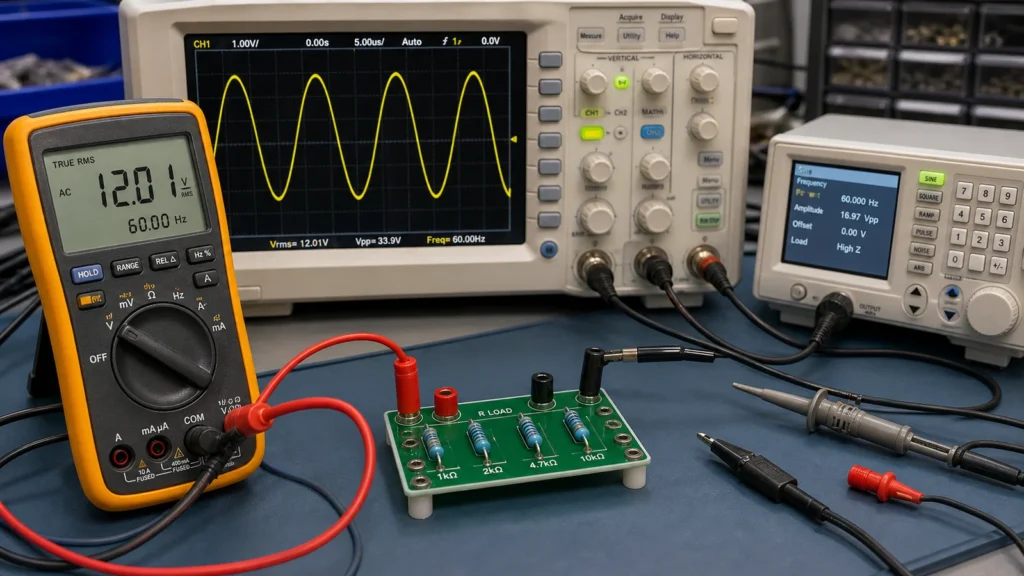
Um multímetro barato que assume uma onda senoidal dará incorretamente Tensão RMS Leituras em um sinal PWM. Se sua medição deve ser precisa em formas de onda arbitrárias, você precisa de um medidor True-RMS.
True-rms vs. medidores de resposta média
Muitos multímetros acessíveis respondem à média: eles medem o valor absoluto médio, multiplicam-se por 1,11 (o fator de forma de onda senoidal) e exibem o resultado como “rms”. Isso é correto apenas para ondas senoidais puras. Alimente uma onda de triângulo para um medidor de resposta média e o valor exibido estará incorreto em cerca de 4%. Alimente um sinal PWM e o erro pode exceder 40%.
Um True-rms O medidor calcula o valor real do RMS amostrando a forma de onda em alta velocidade, ao quadrar cada amostra, a média e a raiz quadrada. Esses medidores lidam corretamente com as formas de onda arbitrárias. Se o seu trabalho envolve saídas do inversor, acionamentos do motor, amplificadores de áudio ou suprimentos não sinusoidais, o True-RMS não é opcional.
Cenários práticos onde o RMS é importante
- Fusível e dimensionamento do disjuntor: Os fusíveis respondem à corrente RMS, não ao pico. Um fusível de 5 A em um circuito com 5 A rms funcionará corretamente. Se o tamanho for baseado na corrente de pico, a classificação do fusível está incorreta.
- Classificações do transformador VA: um transformador avaliado em 100 VA a 120 V RMS pode fornecer cerca de 0,83 A Rms. Exceder isso superaquece os enrolamentos, mesmo que a corrente de pico pareça moderada.
- Manuseio de energia do alto-falante: as especificações do amplificador de áudio usam RMS Watts. Um alto-falante com classificação de 50 W, pode dissipar tanta potência contínua. As classificações de pico de potência (geralmente 2x ou mais) são números de marketing, não de design.
- Corrente de ondulação do capacitor: os capacitores eletrolíticos têm uma classificação máxima de corrente de ondulação RMS. Exceder o aquecimento causa o aquecimento interno e reduz a vida útil do capacitor, mesmo que a tensão CC permaneça dentro da especificação.
- Largura do rastreamento do PCB: As calculadoras de largura do traço usam a corrente RMS para determinar o aumento da temperatura. Os picos de corrente de pico mais curtos que a constante de tempo térmico podem ser aceitáveis, mas a corrente RMS contínua determina a temperatura de estado estacionário.
Como calcular RMS sem memorizar fórmulas
Você não precisa derivar integrais sempre. Aqui está um fluxo de trabalho prático:
- Capture a forma de onda com um osciloscópio. Exporte um CSV de pares de tensão temporal.
- quadrado cada valor de tensão. Em uma planilha, crie uma coluna para V².
- Calcule os valores ao quadrado em um ciclo completo (ou um número inteiro de ciclos).
- Pegue a raiz quadrada dessa média. O resultado é a tensão RMS.
Para uma onda senoidal, o atalho Vᵣₘₛ = Vₚ × 0,707 funciona. Para todo o resto, calcule-o ou use um medidor True-RMS. Adivinhar com a fórmula de onda senoidal em uma forma de onda não senoidal é como os problemas térmicos entram em produção.
Perguntas frequentes
O que é RMS em termos simples?
RMS, ou quadrado médio da raiz, é o valor efetivo de uma tensão ou corrente CA. Ele informa o valor de DC equivalente que produziria o mesmo efeito de aquecimento em um resistor. Uma tomada de parede de 120 V RMS fornece a mesma potência de aquecimento de 120 V DC.
Qual é o significado de RMS em engenharia elétrica?
Na engenharia elétrica, o significado de RMS é a magnitude equivalente a DC de uma forma de onda variável no tempo. É a maneira padrão de expressar as tensões e correntes CA porque se relaciona diretamente com a potência real: P = Vᵣₘₛ × Iᵣₘₛ para cargas resistivas.
Por que o RMS é usado em vez da média?
A média de uma onda senoidal pura em um ciclo completo é zero. Mesmo a média do valor absoluto não prevê corretamente o aquecimento. RMS esquadria os valores antes da média, o que pesa corretamente excursões maiores e produz o valor de aquecimento equivalente em DC.
Preciso de um multímetro True-rms?
Se você medir apenas ondas senoidais puras (paredes de parede, fontes de alimentação lineares), um medidor de resposta média é adequado. Se você trabalha com inversores, unidades de motor, sinais PWM, áudio ou qualquer forma de onda não sinusoidal, um medidor True-RMS é essencial.
Qual é o valor RMS de uma tomada de parede de 120 V?
120 V é o valor RMS. A tensão de pico é de aproximadamente 170 V (120 × √2), e a tensão de pico a pico é de 340 V. É por isso que uma tomada de 120 V RMS pode fornecer um pico de 170 V para um filtro retificador capacitor.
Qual é o RMS de uma onda quadrada?
Para uma onda quadrada ideal que oscila entre +Vₚ e -Vₚ com ciclo de trabalho de 50%, o valor RMS é igual a Vₚ. Não há fator de 0,707 porque a forma de onda gasta igual tempo nos valores de pico positivo e negativo de pico.