1. Выберите тип линии
2. Введите параметры
mils
mils
mils
mils
Схема микрополоска
Формула
Схема полосковой линии
Формула
Схема связанного микрополоска
Формула
Схема связанной полосковой линии
Формула
3. Результаты
Волновое сопротивление (Zo)-- Ω
Дифференциальный импеданс (Zdiff)-- Ω
Отказ от ответственности: Данные расчеты предназначены только для предварительной оценки. Для финального проектирования всегда используйте профессиональное ПО для моделирования.
Проверка исходных данных и результата импеданса
Оценка импеданса печатной платы надежна лишь настолько, насколько точны геометрия и свойства материала. Используйте размеры готового стека, а не номинальную разводку или непрессованный препрег. Все линейные величины задавайте в одной системе единиц и выбирайте верную структуру: поля микрополосковой и полосковой линий распределяются по-разному.
- Геометрия: задайте готовые ширину и толщину дорожки, расстояние до нужного опорного слоя, а для дифференциальной пары — зазор между краями.
- Материал: используйте диэлектрическую проницаемость ламината для рабочей частоты, а не условное значение FR-4.
- Ограничения: маска, шероховатость, трапецеидальное травление, соседняя медь и стеклоткань могут сместить расчет.
- Толкование: считайте результат проектной оценкой. Производитель должен скорректировать геометрию и проверить импеданс полевым решателем и тестовым купоном.
Руководство по эксплуатации
- Выбор типа
трассировки Выберите одну из четырех конфигураций трассировки с визуальными значками:- Микрополоска: одиночная трасса на внешнем слое над заземляющей плоскостью.
- Полосковая линия: трасса, встроенная между двумя заземляющими плоскостями.
- Микрополосковая с краевым соединением: дифференциальная пара на внешнем слое.
- Стриплайн с краевым соединением: дифференциальная пара, встроенная между заземляющими плоскостями.
- Введите параметры
- Диэлектрическая проницаемость (εr): электрическая проницаемость материала (например, 4,4 для FR-4).
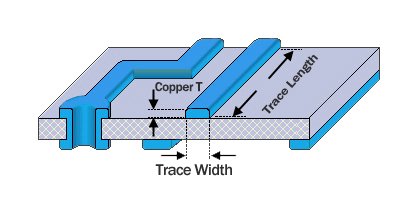
- Толщина трассировки (T): толщина меди в милях (1 унция = 1,37 мили).
- Ширина дорожки (W): ширина проводника в милях.
- Высота подложки (H)/Расстояние между плоскостями (B): Расстояние до заземляющей плоскости (плоскостей).
- Расстояние между дорожками (S): отображается для дифференциальных пар; расстояние между дорожками.
- Просмотр результатов
- Характеристическое сопротивление (Zo): для односторонних трасс.
- Дифференциальный импеданс (Zdiff): для соединенных пар, отображается автоматически для типов с краевым соединением.
Объяснения формул
Односторонний микрополосковый импеданс
Variables:
- Z0: Characteristic impedance of the microstrip line (Ω)
- Key parameter for single-ended signal integrity
- Typical target: 50Ω for RF, 60-70Ω for digital signals
- εr: Substrate dielectric constant
- FR-4: 4.2-4.6 @ 1MHz
- Rogers RO3003: 3.0 @ 10GHz
- H: Substrate height from trace to ground plane (mils)
- Also known as dielectric height
- Thinner H increases Z0 for same trace width
- W: Trace width (mils)
- Wider traces lower Z0 linearly
- Minimum width limited by manufacturing (typically ≥4mils)
- T: Trace thickness (mils)
- 1oz copper: 1.37mils (35μm)
- 2oz copper: 2.74mils (70μm)
Симметричный импеданс полосовой линии
Variables:
- Z0: Characteristic impedance of stripline (Ω)
- Enclosed between two ground planes for better shielding
- Typical target: 50Ω for controlled impedance designs
- εr: Dielectric constant of core material
- High-frequency materials: εr stability critical
- Example: Isola FR408HR: εr=3.48 @ 10GHz
- B: Total distance between ground planes (mils)
- Also called "plane separation" or "stackup height"
- B = 2H for symmetric stripline with centered trace
- W: Trace width (mils)
- Narrower W increases Z0 in stripline designs
- Width-to-thickness ratio affects field distribution
- T: Trace thickness (mils)
- Thicker traces reduce DC resistance but impact Z0 slightly
- Considered in denominator for geometric correction
Дифференциальный импеданс микрополосковой линии с краевым соединением
Variables:
- Zdiff: Differential impedance of coupled microstrip (Ω)
- Typical targets: 100Ω (USB), 90Ω (Ethernet)
- Depends on both single-ended Z0 and coupling factor
- Z0: Single-ended microstrip impedance (Ω)
- Base impedance of each trace in the pair
- Assumes infinite ground plane for isolation
- S: Spacing between coupled traces (mils)
- Critical for crosstalk and differential impedance control
- S/H ratio determines exponential coupling factor
- Common rule: S ≥ 2W for minimal crosstalk
- H: Substrate height (mils)
- Affects field penetration into substrate
- Lower H increases electromagnetic coupling between traces
Дифференциальный импеданс полосковой линии с краевым соединением
Variables:
- Zdiff: Differential impedance of coupled stripline (Ω)
- Preferred for high-speed signals requiring low EMI
- Typical value: 100Ω for DDR4 differential pairs
- Z0: Single-ended stripline impedance (Ω)
- Impedance of each trace when isolated
- Calculated using symmetric stripline formula
- S: Spacing between coupled traces (mils)
- Smaller S increases differential impedance due to coupling
- Exponential term: e-1.5S/B models field overlap
- B: Plane separation (mils)
- Total distance between top and bottom ground planes
- B = 2H for centered traces in symmetric stackups
- Larger B reduces coupling effect for same trace spacing
Часто задаваемые вопросы
Что такое характеристическое сопротивление (Z0)?
Characteristic impedance is the resistance a signal "sees" as it travels along a transmission line, determined by trace geometry and material properties. A mismatch in Z0 causes signal reflections, degrading integrity. For example, a microstrip with W = 10 mils, H = 6 mils, and εr = 4.4 has:
Z0 =
87
√
(εr + 1.41)
· ln(
5.98 · H
0.8 · W + T
) ≈ 50 Ω
В чем разница между микрополосковой и полосковой линией?
- Microstrip: Single trace on the surface with a ground plane below.
- Advantages: Easy to route, suitable for low-frequency designs.
- Disadvantages: Radiates EMI, sensitive to board flexing.
- Stripline: Trace sandwiched between two ground planes.
- Advantages: Better EMI shielding, stable at high frequencies.
- Disadvantages: Requires inner layers, more complex to route.
Как расстояние между дорожками влияет на дифференциальный импеданс?
In edge-coupled pairs, increased spacing S reduces electromagnetic coupling, increasing differential impedance Zdiff. For microstrips:
Zdiff = 2 · Z0 · (1 − 0.347 · e−2.9S/H)
- When S = H: Zdiff ≈ 2Z0 · 0.76
- When S = 3H: Zdiff ≈ 2Z0 · 0.97
В чем разница между односторонним и дифференциальным импедансом?
| Parameter | Single-Ended (Z0) | Differential (Zdiff) |
|---|---|---|
| Definition | Impedance from trace to ground | Impedance between two coupled traces |
| Typical Values | 50Ω (RF), 60-70Ω (digital) | 100Ω (USB), 90Ω (Ethernet) |
| Application | Single-ended signals (e.g., GPIO) | Differential signals (e.g., LVDS, PCIe) |
| Design Focus | Trace width and ground plane distance | Trace spacing and coupling coefficient |
Differential pairs offer better noise immunity because the differential signal cancels common-mode noise. For example, USB 3.0 requires with and on a 6-mil FR-4 substrate.
Почему для дифференциальных пар следует выбирать микрополосковую линию с краевым соединением, а не полосковую линию?
- Микрополоска: проще в прокладке, но излучает электромагнитные помехи и чувствительна к изгибу платы.
- Стриплайн: Лучшее экранирование, меньшее перекрестное влияние и большая стабильность на высоких частотах, но требует внутренних слоев.
Какую роль играет диэлектрическая проницаемость (εr) в импедансе?
A higher εr increases the effective permittivity of the transmission line, decreasing Z0. For example:
- FR-4 (εr = 4.4): Z0 ≈ 50 Ω for W = 10 mils, H = 6 mils
- Rogers RO3003 (εr = 3.0): Z0 ≈ 58 Ω for the same geometry
Key Dielectric Properties
- εr: Relative permittivity, affects field confinement.
- High-frequency materials: εr stability is critical
- Example: Isola FR408HR: εr = 3.48 @ 10GHz
- Loss Tangent (Df): Energy loss factor, impacts signal attenuation.
- FR-4: Df ≈ 0.02 @ 1MHz
- Rogers RO4350B: Df = 0.004 @ 10GHz
Насколько точны эти расчеты?
Results are based on IPC-standard approximations. Real-world factors like:
- Trace roughness (e.g., 2.1μm RMS)
- Solder mask thickness (0.5-1.0mils)
- Manufacturing tolerances (±10% for trace width)
- Dielectric thickness variation (±5%)